How Does Charcoal Filter Water
When you use charcoal to filter water, you rely on its highly porous structure to trap contaminants through adsorption. Charcoal filter water systems pull impurities like organic compounds and chlorine onto the surface and within tiny pores.
However, the effectiveness depends on factors like pore size, contact time, and flow rate. Understanding how these variables interact can help you determine when charcoal filtering meets your water quality needs—and when it might fall short.
Key Takeaways
- Activated charcoal filters remove impurities by adsorbing contaminants onto a highly porous surface with extensive micro-, meso-, and macropores.
- The filter’s large surface area and pore structure enable effective capture of organic chemicals like chlorine, VOCs, and pesticides from water.
- Water flows through the charcoal pores, allowing contaminants to diffuse and bind to surface functional groups via physical and chemical interactions.
- Charcoal filters reduce chemical contaminants efficiently but have limited effectiveness against inorganic substances and microbial pathogens.
- Filter lifespan, contact time, and flow rate influence adsorption efficiency and require regular replacement for optimal water purification.
What Is Activated Charcoal and How Is It Made?
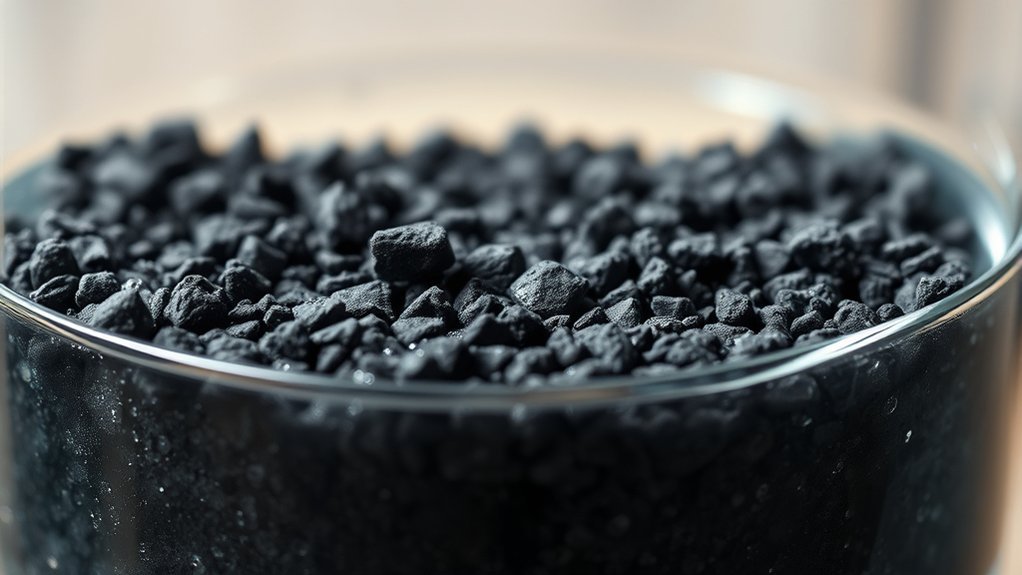
What makes activated charcoal distinct from regular charcoal? Activated charcoal undergoes a specialized manufacturing process involving high-temperature activation, which markedly enhances its pore structure. This expanded pore network optimizes adsorption dynamics, making it highly effective for contaminant removal.
When selecting filter types, you’ll notice activated charcoal excels in taste improvement and extends filter longevity due to its superior filtration mechanism. Your selection criteria should include pore size distribution and surface area, as these factors directly influence filtration efficacy.
Unlike regular charcoal, which lacks sufficient porosity, activated charcoal’s refined structure captures impurities more efficiently. Understanding these technical aspects helps you appreciate why activated charcoal is the preferred medium in water filtration systems, balancing performance and durability to maintain water quality consistently.
How Do Charcoal Filters Trap Impurities?
You rely on charcoal filters to trap impurities through a process called adsorption, where contaminants adhere to the filter’s surface. The filter’s highly porous structure increases the surface area, enhancing its ability to capture particles and chemicals.
Understanding this mechanism helps you see why charcoal filters are effective in purifying water.
Adsorption Process Explained
Although charcoal filters appear simple, they rely on a complex adsorption process to trap impurities effectively. You’ll find that adsorption efficiency depends largely on the interaction between contaminants and the charcoal’s surface functional groups.
These groups attract and bind impurities through physical and chemical forces, enabling the filter to remove toxins and odors from water.
| Parameter | Description | Impact on Adsorption |
|---|---|---|
| Surface Functional Groups | Chemical sites on charcoal | Enhance binding affinity |
| Adsorption Efficiency | Percentage of impurities removed | Indicates filter performance |
| Contact Time | Duration water interacts | Affects impurity capture rate |
Pore Structure Function
Understanding the pore structure of charcoal is essential for grasping how these filters trap impurities. Charcoal’s extensive network of micro-, meso-, and macropores creates a high surface area, critical for adsorption dynamics.
As water passes through, contaminants diffuse into these pores, where van der Waals forces and other intermolecular interactions hold them. The pore size distribution influences which molecules are adsorbed; smaller pores target organic compounds while larger ones trap particulates.
You’ll find that adsorption efficiency depends on how well the pore structure matches the size and properties of impurities. By optimizing this structure, charcoal filters maximize contact time and surface interactions, effectively reducing contaminants.
This precise interplay between pore structure and adsorption dynamics is what makes charcoal filters highly effective in water purification.
Which Contaminants Can Charcoal Filters Remove?

You’ll find that charcoal filters effectively remove common chemical contaminants like chlorine, pesticides, and volatile organic compounds. However, their impact on microbial impurities such as bacteria and viruses is limited and inconsistent.
Understanding these capabilities helps you evaluate when charcoal filtration suits your water treatment needs.
Common Chemical Contaminants
Which chemical contaminants can charcoal filters effectively remove from water? Activated carbon, utilized in charcoal filters, excels at chemical adsorption, targeting organic compounds and chlorine-based substances.
You’ll find that these filters efficiently reduce volatile organic compounds (VOCs), pesticides, herbicides, and industrial solvents by trapping them within the porous structure of activated carbon. Additionally, they mitigate chlorine and chloramine, improving taste and odor.
However, charcoal filters have limited efficacy against inorganic chemicals like heavy metals and nitrates, as these do not adsorb well onto activated carbon. Understanding these capabilities helps you select appropriate filtration for your water quality needs.
Impact on Microbial Impurities
While charcoal filters excel at removing many chemical contaminants, their ability to address microbial impurities is more limited. Charcoal primarily functions through adsorption, which is less effective against microorganisms such as bacteria and viruses.
You should be aware that some bacteria exhibit microbial resistance, enabling them to survive standard charcoal filtration. Additionally, biofilm formation on the filter surface can further reduce effectiveness by shielding microbes from contact with the charcoal.
Although charcoal filters may reduce some microbial load by trapping larger particles, they do not provide reliable disinfection. For comprehensive microbial removal, you’ll need to complement charcoal filtration with methods like UV treatment or chemical disinfection.
Understanding these limitations helps you select appropriate water treatment strategies tailored to microbial safety requirements.
Why Do Charcoal Filters Improve Water Taste and Odor?
How exactly do charcoal filters enhance the taste and odor of water? The improvement stems from the filter’s ability to interact with taste mechanisms and odor chemistry at a molecular level.
Charcoal’s porous structure adsorbs compounds responsible for unpleasant flavors and smells, altering your sensory experience. Specifically, charcoal filters:
- Remove organic compounds like chlorine and volatile sulfur, which disrupt taste mechanisms by imparting bitterness or metallic notes.
- Adsorb odor-causing molecules, neutralizing sulfurous or musty smells linked to odor chemistry.
- Trap particulate matter that can carry taste- and odor-affecting substances, further refining water quality.
How Long Do Charcoal Filters Last?

When should you replace your charcoal filter to maintain peak performance? The filter lifespan typically ranges from three to six months, depending on water quality and usage frequency.
You’ll want to adhere to a strict maintenance schedule to prevent saturation and microbial growth, which degrade filtration efficiency. Factors influencing filter lifespan include contaminant load, water flow rate, and filter size.
Exceeding the recommended replacement interval reduces adsorption capacity, allowing impurities to pass through. To optimize performance, monitor water taste, odor, and flow rate as indicators of filter exhaustion.
Replacing the charcoal filter promptly ensures consistent removal of chlorine, volatile organic compounds, and other pollutants. Maintaining your filter according to manufacturer guidelines preserves water purity and prolongs the overall system’s durability.
Types of Charcoal Filters and Their Best Uses
Which type of charcoal filter suits your water purification needs best? Understanding the options helps address common charcoal filtration challenges effectively. Here are key types to consider:
- Granular Activated Carbon (GAC): Offers high surface area for adsorption, ideal for removing chlorine and organic compounds but less effective against microorganisms.
- Carbon Block Filters: Provide a denser structure for finer filtration, improving removal of sediments and some pathogens, though they may clog faster.
- Powdered Activated Carbon (PAC): Used in large-scale treatment for rapid contaminant adsorption but requires additional filtration steps.
This breakdown provides discussion ideas about each filter’s best applications, emphasizing that choosing the right type depends on your specific water quality concerns and treatment goals.
How to Choose the Right Charcoal Water Filter for You
What factors should you weigh to select the most effective charcoal filter for your water? First, analyze your water quality to identify contaminants requiring removal. Consider filter type, granular activated carbon or carbon block, each offering different adsorption capacities.
Evaluate flow rate and filter lifespan to ensure efficiency and maintenance convenience. Be aware of hygiene myths suggesting charcoal filters harbor bacteria; proper replacement schedules prevent this risk.
Likewise, installation myths claiming complex setups deter users are unfounded. Many filters are designed for straightforward, tool-free installation. Assess certifications like NSF/ANSI standards to confirm performance claims.
Frequently Asked Questions
Can Charcoal Filters Remove Bacteria From Water?
You can’t rely on charcoal filters alone for bacteria filtration; they primarily remove metals and chemicals. For effective bacteria removal, you need additional treatments like UV or chemical disinfectants alongside charcoal filtration.
How Often Should Charcoal Filters Be Cleaned?
You should clean your charcoal filter every 3 to 6 months to maintain optimal performance. Studies show improper maintenance reduces filtration efficiency by 40%.
Regular cleaning frequency and maintenance tips ensure prolonged filter lifespan and water quality.
Are Charcoal Filters Safe for Aquarium Water?
Yes, you can trust charcoal filters for aquarium safety. Carbon filtration effectively removes impurities and toxins without harming aquatic life, ensuring a clean environment.
Just maintain and replace the filter regularly to sustain optimal water quality.
Can Charcoal Filters Remove Heavy Metals Completely?
You won’t find a charcoal filter that banishes heavy metals like a superhero, but its filtration mechanisms can reduce many metals effectively. However, complete removal often requires additional specialized treatments for thorough purification.
Do Charcoal Filters Affect the pH of Water?
Charcoal filtration generally has minimal pH implications, so you won’t see significant changes. It effectively aids bacteria removal and heavy metals capture.
Ensure regular filter maintenance to maintain aquarium safety and optimal water quality.
Conclusion
You might think charcoal filters just trap impurities, but they actually transform your water by adsorbing molecules on a microscopic scale, improving taste and safety. While they excel at removing organics and chlorine, remember they aren’t a catch-all solution for metals or microbes.
Choosing the right filter means understanding pore structure and flow rates, because, like a key fitting a lock, the perfect match ensures water purification every time.
When selecting a charcoal filter, keeping these factors in mind will help you achieve the best results in charcoal filter water treatment.