What Is the Freezer Temp
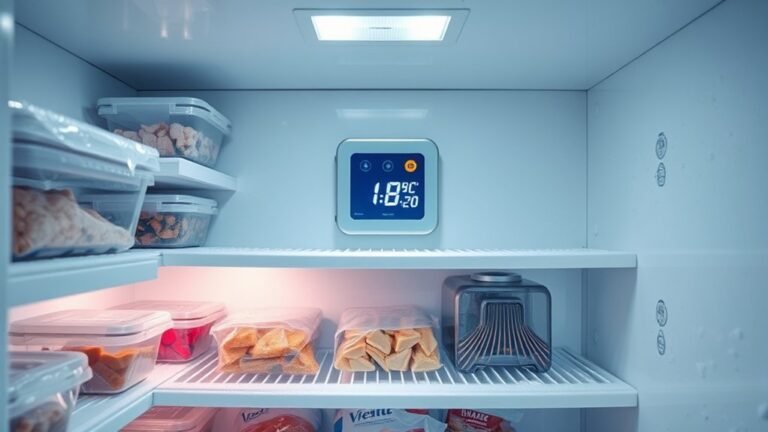
You want to preserve freshness, prevent spoilage, and maintain nutritional value, all by setting the right freezer temperature. The ideal target is 0°F (-18°C), which effectively slows microbial growth while balancing energy use. But how do you ensure your freezer stays at this critical point without going too cold or fluctuating too much?
Understanding these nuances can greatly impact food safety and quality. Maintaining a consistent freezer temperature helps keep your food safe and fresh for longer periods. Regularly checking the temperature with an appliance thermometer can prevent unexpected thawing or freezer burn.
Key Takeaways
- The ideal freezer temperature is 0°F (-18°C) for optimal food preservation and safety.
- Temperatures between 0°F (-18°C) and 5°F (-15°C) balance safety and energy efficiency.
- Freezer temperatures above -12°C (10°F) increase the risk of food spoilage.
- Regularly monitor freezer temperature with an accurate thermometer placed away from vents and doors.
- Avoid setting freezer below -25°C (-13°F) to prevent energy waste without preservation benefits.
What’s the Best Freezer Temperature for Keeping Food Safe?
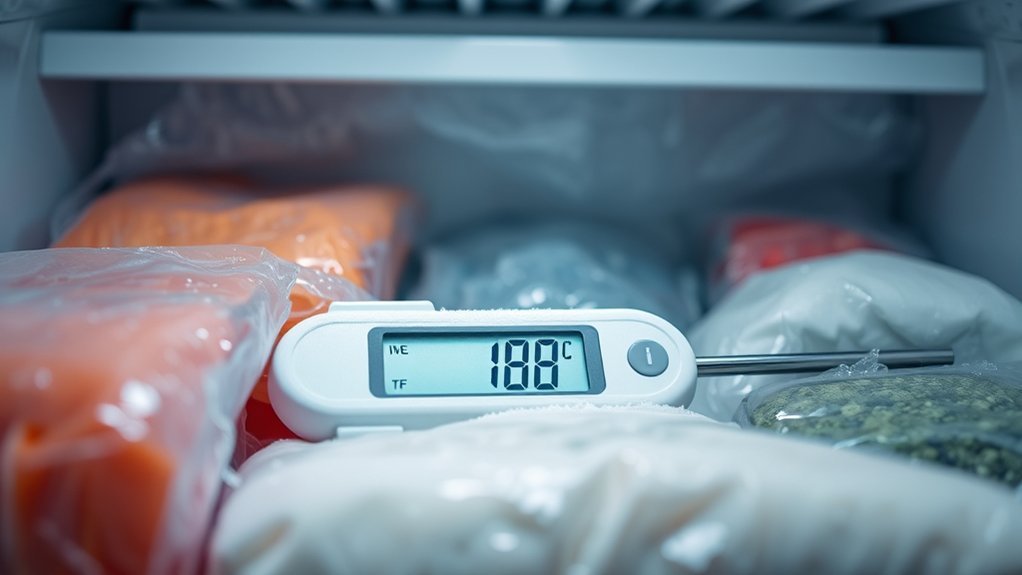
How cold should your freezer be to keep food safe? The optimal temperature is 0°F (-18°C). At this level, microbial growth halts, ensuring safe meat storage and preserving texture and nutrients.
Maintaining this temperature balances safety with energy efficiency; colder settings consume more power without significantly extending shelf life. You should monitor your freezer with an accurate thermometer to keep it consistently at or below this threshold.
Avoid frequent temperature fluctuations, as they can degrade food quality and increase energy use. Proper sealing and organization also enhance efficiency by minimizing cold air loss.
Freezer Temperature Myths You Shouldn’t Believe
You might think setting your freezer colder than necessary improves food preservation, but that’s a common misconception. Understanding the ideal freezer temperature helps avoid energy waste and maintains food quality.
Let’s examine these myths and the impact of incorrect temperature settings.
Ideal Freezer Temperature
Why does setting the correct freezer temperature matter? It ensures optimal food preservation, maintains energy efficiency, and supports accurate storage labeling. The ideal temperature prevents bacterial growth and freezer burn while reducing electricity consumption.
For most freezers, -18°C (0°F) is the recommended setting, balancing safety and efficiency.
| Temperature Setting | Purpose |
|---|---|
| -18°C (0°F) | Ideal for long-term storage |
| -15°C (5°F) | Shorter storage periods |
| -23°C (-10°F) | Deep freezing, max preservation |
| Above -12°C (10°F) | Risk of food spoilage |
| Below -25°C (-13°F) | Excessive energy use |
Set your freezer at -18°C to maximize food quality and energy savings while facilitating precise storage labeling.
Common Freezer Temperature Myths
Which freezer temperature myths might be misleading your food storage practices? Many storage myths circulate, often fueled by appliance jargon that confuses rather than clarifies. For example, you might hear that setting your freezer colder than -18°C (-0.4°F) preserves food longer, but scientifically, temperatures below this threshold offer no significant benefit.
Another common myth is that frequent door openings drastically alter internal temperature; modern freezers use advanced insulation and compressors that quickly restore set temps. You may also believe that freezer frost buildup indicates malfunction, whereas it often results from humidity intrusion, not temperature error.
Effects Of Incorrect Temperatures
Misunderstanding freezer temperature myths can lead to improper settings that compromise food quality and safety. When temperatures are too high, microbial growth accelerates, causing spoilage and increasing health risks.
Conversely, excessively low temperatures can cause freezer burn, deteriorating texture and flavor. You must maintain the recommended temperature, typically around 0°F (-18°C), to guarantee optimal preservation.
Incorrect settings also affect energy efficiency; a freezer set colder than necessary consumes more power without added benefit. Additionally, improper labeling during storage becomes problematic if you can’t rely on the correct preservation conditions, increasing the risk of consuming degraded or unsafe food.
How to Check and Monitor Your Freezer Temperature
How often should you check your freezer’s temperature to ensure optimal food preservation? Ideally, you should verify it at least once a week using a reliable appliance thermometer. Place the thermometer in the center of the freezer, away from walls, to avoid false readings caused by poor air circulation.
Monitor the temperature closely, ensuring it stays consistently at or below 0°F (-18°C). Frequent checks help you detect fluctuations that could compromise food safety and energy efficiency.
Additionally, consider using digital thermometers with alarms to alert you of deviations. Maintaining an accurate temperature not only preserves food quality but also optimizes energy consumption, reducing operational costs and extending your freezer’s lifespan.
Regular monitoring is a straightforward, effective method to prevent costly issues.
Tips to Adjust Your Freezer to the Perfect Temperature
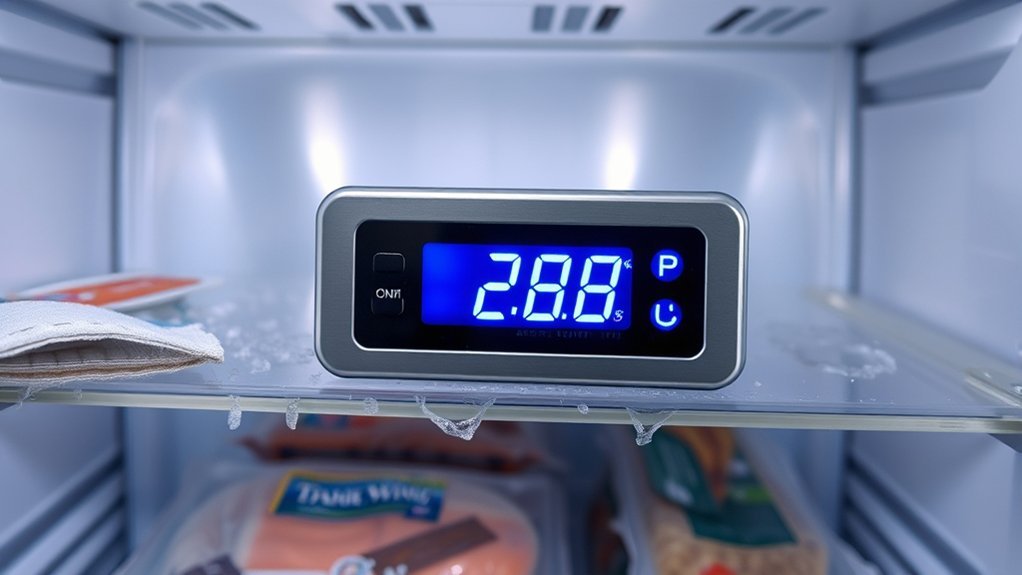
You’ll want to set your freezer between 0°F and 5°F to maintain optimal food preservation. Use a reliable thermometer to monitor the exact temperature, as built-in gauges can be inaccurate.
When adjusting settings, make incremental changes and allow the freezer several hours to stabilize before rechecking.
Ideal Freezer Temperature Range
Although freezer models vary, maintaining an ideal temperature range between 0°F (-18°C) and 5°F (-15°C) ensures optimal food preservation and energy efficiency. You might encounter storage myths suggesting colder settings improve safety, but setting your freezer too low wastes energy without added benefit.
Staying within this range balances appliance efficiency and food quality by preventing freezer burn and bacterial growth.
| Temperature (°F) | Effect on Food & Appliance |
|---|---|
| 0°F (-18°C) | Optimal preservation, highest safety |
| 2°F (-17°C) | Maintains quality, good energy use |
| 5°F (-15°C) | Acceptable, slightly less energy efficient |
| >5°F (> -15°C) | Risk of spoilage, reduced appliance efficiency |
Adjust smartly to avoid inefficiency and debunk storage myths effectively.
How To Use Thermometers
Why rely on guesswork when adjusting your freezer temperature? To ensure accuracy, keep a thermometer inside your freezer at all times. Position it away from the door and cooling vents to avoid blind spots where temperature readings can be misleading.
Regularly check the thermometer to monitor fluctuations and verify that the freezer maintains the optimal temperature range. Use a digital or dial thermometer with a clear, easy-to-read display for precise readings.
Avoid placing the thermometer near frozen items that might insulate or skew the results. By keeping the thermometer strategically placed, you gain reliable data to fine-tune your freezer settings confidently, ensuring food safety and energy efficiency without relying on assumptions or guesswork.
Adjusting Freezer Settings Properly
Monitoring your freezer’s temperature with a thermometer gives you the data needed to make precise adjustments. Start by noting the current temperature and comparing it to the ideal -18°C (0°F).
If readings deviate, adjust the thermostat incrementally, allowing 24 hours between changes for stabilization. Regular freezer calibration is essential; verify accuracy by placing the thermometer in an ice-water slurry (0°C/32°F) and recalibrate if necessary.
Watch for frost buildup, as excessive frost insulates and disrupts temperature consistency. Defrost manually when frost exceeds ¼ inch thickness, then reset settings.
Ensure vents remain unobstructed to promote even airflow. By methodically calibrating and monitoring frost levels, you maintain optimal freezer performance, preserving food safety and energy efficiency without guesswork or overcompensation.
How Freezer Temperature Affects Food Safety, Quality, and Shelf Life
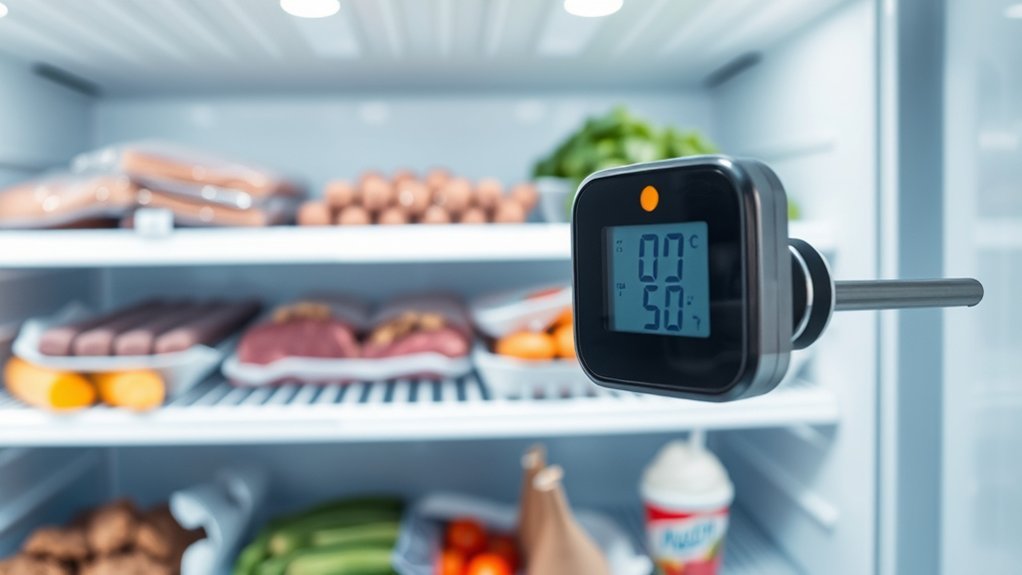
How does freezer temperature directly impact the safety, quality, and shelf life of your stored food? Maintaining an optimal temperature, typically at or below 0°F (-18°C), slows enzymatic activity and microbial growth, ensuring food safety and prolonging shelf life.
For snack storage, consistent low temperatures prevent moisture migration, preserving texture and preventing spoilage. Ice cream consistency depends heavily on stable freezing conditions; fluctuations cause ice crystal formation, degrading texture and flavor.
Deviations from recommended temperatures accelerate nutrient loss and quality decline, shortening usability. By controlling freezer temperature precisely, you minimize risks of freezer burn and bacterial proliferation, maximizing both safety and sensory attributes.
Thus, understanding and maintaining correct freezer temp is essential to safeguard your food’s integrity and extend its storage potential efficiently.
What Happens When Your Freezer Is Too Warm or Too Cold?
Maintaining the right freezer temperature directly influences food preservation, but when temperatures stray too high or drop excessively low, specific issues arise. If your freezer is too warm, food safety risks increase due to incomplete freezing, and energy efficiency drops as the compressor works harder.
Proper freezer temperature is crucial to food safety and energy efficiency, preventing spoilage and compressor strain.
Conversely, excessively cold temperatures can cause frost buildup, which impedes airflow and reduces noise reduction effectiveness. Frost accumulation triggers more frequent defrost cycle activations, increasing energy consumption and wear on components.
You’ll also notice diminished storage capacity as ice occupies space. Balancing temperature avoids these problems by optimizing energy efficiency and minimizing frost buildup, ensuring reliable food preservation without excessive noise or energy waste.
Monitoring and adjusting your freezer settings prevents these technical inefficiencies and protects both your food and appliance longevity.
Best Freezer Temperature Tips for Storing Meat, Veggies, and Prepared Foods
Why does setting the right freezer temperature matter when storing meat, vegetables, and prepared foods? Proper temperature control ensures optimal freezer health, preventing spoilage and nutrient loss. Here are four precise tips to maintain food quality and safety:
- Maintain -18°C (0°F) consistently to inhibit bacterial growth and preserve texture.
- Separate – Use airtight containers or vacuum seal bags to avoid cross-contamination and freezer burn.
- Label – Date and categorize items clearly to monitor storage duration and reduce waste.
- Rotate – Follow the “first in, first out” method to use older items promptly, enhancing food safety.
These two word discussion ideas, “temperature control” and “storage optimization,” highlight how precise freezer management maximizes shelf life and maintains food integrity.
How the Right Freezer Temp Saves Money and Cuts Food Waste
Setting your freezer to the correct temperature directly impacts your budget and waste management. Maintaining a stable temperature around 0°F (-18°C) prevents ice crystal formation that degrades food quality, reducing spoilage and, consequently, food waste.
Setting your freezer to 0°F (-18°C) preserves food quality and reduces both waste and costs.
This precision challenges common budget myths suggesting colder settings save more energy. In reality, excessively low temperatures increase energy consumption without improving preservation, negating potential energy savings.
By optimizing the freezer temperature, you minimize both electricity costs and the frequency of replacing spoiled items. Proper temperature control ensures food remains safe longer, maximizing your investment in groceries.
Avoiding unnecessary energy use while preserving food quality strikes a balance that benefits your wallet and the environment, dispelling misconceptions about freezer settings and reinforcing efficient household management.
Frequently Asked Questions
What Types of Freezers Are Available for Home Use?
You’ll find upright, chest, and drawer freezers for home use. Each type offers distinct freezer organization and type-specific sizing, so you can optimize space and accessibility based on your storage needs and kitchen layout.
How Does Freezer Temperature Vary by Freezer Type?
You’ll see freezer types as icy guardians, each holding frost at varying depths; upright models hover near -18°C. Chest freezers dive deeper, reaching colder zones, making temperature variation critical for optimal food preservation and energy use.
Can Freezer Temperature Affect Appliance Energy Consumption?
Yes, freezer temperature directly influences freezer energy consumption. When you adjust temperature variation lower than necessary, your appliance works harder, increasing freezer energy use.
Maintaining optimal settings minimizes energy waste and enhances overall efficiency.
What Maintenance Is Needed to Keep a Freezer Running Well?
You can’t neglect maintenance reminders if you want your freezer to run like a finely tuned machine. Prioritize defrosting best practices, clean coils, and check seals regularly to ensure peak efficiency and prevent costly malfunctions.
How Do Power Outages Impact Freezer Temperature and Food?
Power outages cause rapid temperature rises, increasing spoilage risks. You’ll face power loss risks like thawed food and bacterial growth, so minimize door openings and use appliance thermometers to monitor freezer temperature during outages.
Conclusion
You might think keeping your freezer colder than 0°F (-18°C) preserves food better, but excessively low temperatures waste energy and risk freezer burn. Sticking to the ideal 0°F balances safety, texture, and nutrient retention, while minimizing energy costs.
Use a reliable thermometer to monitor and adjust as needed. This precise control not only extends shelf life but also reduces food waste and saves money.
Maintaining the correct freezer temp is a smart, efficient choice for your kitchen.