What Is Reverse Osmosis Water Filter
If you’re concerned about water quality, understanding what a reverse osmosis water filter does is essential. This system uses applied pressure to push water through a semipermeable membrane, effectively separating contaminants from clean water. It’s a precise method that targets dissolved solids and microbes, offering a level of purification beyond many conventional filters.
But how exactly does this process work, and what components make it so effective?
Key Takeaways
- Reverse osmosis (RO) filters use a semipermeable membrane and pressure to remove dissolved solids and contaminants from water.
- RO membranes have microscopic pores (~0.0001 microns) that block salts, heavy metals, microbes, and organic chemicals.
- RO produces highly purified water with improved taste and fewer off-flavors compared to basic carbon or ceramic filters.
- The system requires periodic membrane and filter replacements and generates wastewater during filtration.
- RO systems typically have slower flow rates but offer superior contaminant removal and support environmental sustainability.
What Is a Reverse Osmosis Water Filter?
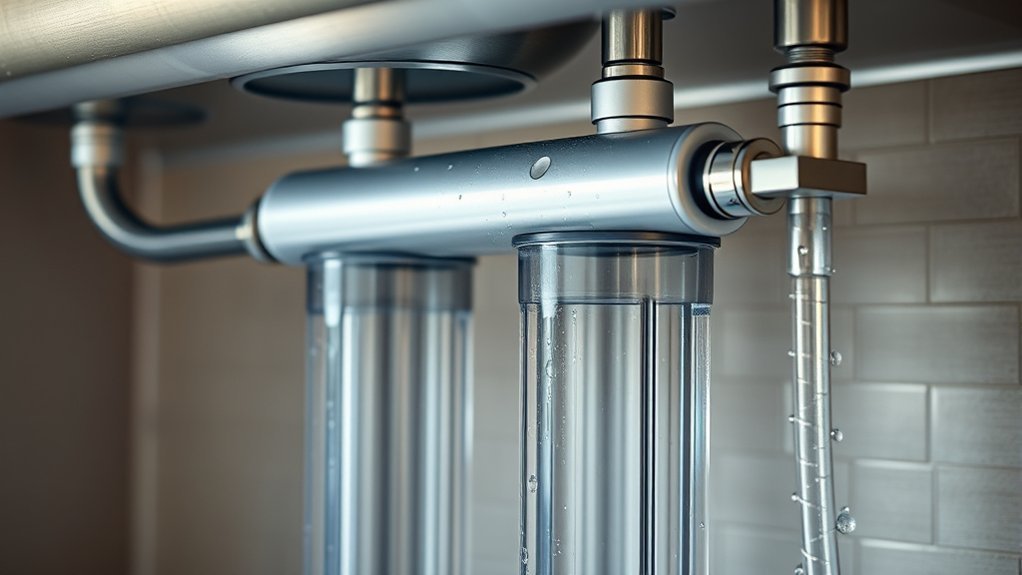
How does a reverse osmosis water filter work? You’ll find it employs a semipermeable membrane to separate impurities from water, ensuring purity that often surpasses regulatory standards. Unlike basic filtration, reverse osmosis forces water through this membrane under pressure, removing dissolved solids and contaminants.
When you conduct taste testing, you’ll notice a marked difference. Water feels crisper, cleaner, and free from off-flavors caused by minerals or chemicals. These filters adhere to strict regulatory standards to guarantee both safety and efficiency, making them reliable for residential or commercial use.
Understanding this technology requires recognizing that it’s not just about filtering; it’s about molecular separation, achieved by pushing water against natural osmotic pressure. This precision makes reverse osmosis filters essential for delivering high-quality drinking water.
How Does Reverse Osmosis Remove Contaminants?
Why does reverse osmosis effectively eliminate contaminants? It relies on a semipermeable membrane that selectively blocks impurities based on size and charge. When you apply pressure to the feed water, it forces water molecules through this membrane, leaving behind contaminants.
Reverse osmosis uses a semipermeable membrane and pressure to separate pure water from contaminants by size and charge.
This two word ideas1 process ensures only pure water passes, while dissolved solids and organic compounds are rejected. The membrane’s microscopic pores, typically around 0.0001 microns, act as a physical barrier, enabling two word ideas2 separation at a molecular level.
You control variables like pressure and flow rate to optimize filtration efficiency. This precise mechanism contrasts with conventional filters by targeting a broader contaminant spectrum with high accuracy.
Understanding this helps you appreciate the advanced technology that underpins reverse osmosis water filters.
Common Impurities Removed by Reverse Osmosis Water Filters

By harnessing the selective properties of the semipermeable membrane, reverse osmosis systems effectively target a wide range of contaminants. When you dive beyond DIY myths and filtration jargon, you’ll see that these filters excel at removing impurities that standard filtration can’t handle.
Here are four common contaminants RO filters remove:
- Dissolved Salts Including sodium, chloride, and calcium ions responsible for water hardness.
- Heavy Metals Such as lead, mercury, and arsenic, which pose significant health risks.
- Microorganisms Including bacteria and viruses, ensuring microbiological safety.
- Organic Chemicals Pesticides and volatile organic compounds that affect taste and safety.
Understanding these removes confusion often caused by oversimplified DIY myths and technical jargon, helping you make informed filtration decisions.
Benefits of Using Reverse Osmosis Water Filters
What makes reverse osmosis water filters stand out in water purification? The benefits overview highlights their exceptional ability to remove dissolved solids, heavy metals, and contaminants with remarkable efficiency. You get consistently high-quality water, free from impurities that other systems might miss.
Additionally, these filters improve taste and odor, enhancing your drinking experience. From a maintenance considerations perspective, reverse osmosis systems require periodic membrane replacement and filter changes, but these tasks are straightforward and infrequent compared to the performance gains.
You also benefit from reduced reliance on bottled water, supporting environmental sustainability. Overall, reverse osmosis filters provide precise contaminant removal and reliable water quality, making them a superior choice if you want to ensure safe, clean water with manageable upkeep demands.
Essential Components of a Reverse Osmosis Water Filter

A reverse osmosis water filter relies on several critical components that work together to ensure effective purification. Understanding these elements is key to grasping how the system employs irreversible processes and membrane chemistry to remove contaminants.
- Pre-filters: Remove larger particles, protecting the RO membrane and enhancing its lifespan.
- RO Membrane: The core component where membrane chemistry allows selective permeability, rejecting dissolved solids and impurities.
- Post-filters: Polish the water by removing any residual tastes or odors post-filtration.
- Storage Tank: Holds purified water under pressure, ensuring immediate availability.
Each component performs a specific role, ensuring that irreversible processes within the membrane lead to efficient contaminant rejection while maintaining water quality.
How to Install a Reverse Osmosis Water Filter at Home
Understanding the key components of a reverse osmosis water filter lays the groundwork for proper installation. Begin by selecting a suitable location under your sink or near the water source, ensuring easy access for future filter replacement and maintenance.
Shut off the water supply and relieve pressure by opening a faucet. Connect the feed water adapter to the cold water line, then attach tubing from the adapter to the RO membrane housing. Securely mount the filter system using brackets, considering your filter budget when choosing compatible parts.
Install the storage tank and faucet, connecting them with the provided tubing. Finally, check all connections for leaks and flush the system according to manufacturer instructions. This precise approach ensures an efficient home setup delivering purified water reliably.
Simple Maintenance Tips for Reverse Osmosis Water Filters
You should replace your reverse osmosis filters according to the manufacturer’s recommended schedule to maintain optimal performance.
Regular cleaning and sanitizing of the system prevent bacterial growth and ensure water quality. Following these maintenance steps helps extend the lifespan of your filter and keeps your water safe.
Filter Replacement Schedule
When should you replace the filters in your reverse osmosis system to maintain optimal performance? Timely filter replacement is crucial for ensuring home sanitation and preserving mineral balance in your water. Neglecting this schedule can compromise water quality and system efficiency.
Follow this replacement timeline:
- Pre-filters (sediment and carbon): every 6-12 months to prevent clogging and maintain flow rate.
- RO membrane: every 2-3 years, depending on water quality and usage to ensure contaminant rejection.
- Post-filters (carbon): every 12 months to enhance taste and remove residual odors.
- Mineral filters (if applicable): every 12 months to maintain proper mineral content and water pH.
Adhering to this schedule optimizes performance and supports your system’s longevity.
Cleaning and Sanitizing Methods
Keeping your reverse osmosis system clean and sanitized plays a critical role in sustaining water quality and system efficiency. You should regularly disinfect the system using a food-grade sanitizer, ensuring all components, including the membrane housing and storage tank, are thoroughly cleaned.
Flushing the system after sanitization prevents chemical residues that could affect taste and safety. Pay attention to the filter housing seals to avoid leaks that could compromise home aesthetics. Maintaining your system aligns with groundwater ethics by preventing contamination and promoting sustainable water use.
You must also inspect and clean pre-filters to reduce biofilm buildup, which impairs membrane performance. Establishing a routine cleaning schedule based on manufacturer guidelines optimizes system longevity and ensures your reverse osmosis filter consistently delivers high-purity water.
Comparing Reverse Osmosis Water Filters to Other Filters
How does reverse osmosis (RO) compare to other common water filtration methods regarding effectiveness and efficiency? When you engage in two word discussion ideas like “comparative filters,” you’ll notice RO excels in contaminant removal but varies in operational demands.
- Filtration Depth: RO removes dissolved solids and microbes more thoroughly than carbon or ceramic filters.
- Flow Rate: RO systems typically deliver slower output due to membrane permeability constraints.
- Maintenance: RO membranes require periodic replacement, unlike simpler sediment filters.
- Waste Production: RO generates wastewater, a factor absent in many alternative filters.
These points highlight that RO’s advanced filtration comes with trade-offs in efficiency and operational complexity, making comparative filters a vital consideration for your water treatment needs.
Is a Reverse Osmosis Water Filter Right for You?
You’ll need to assess your water quality to determine if reverse osmosis effectively addresses your contaminants. Consider the installation complexity and ongoing maintenance requirements before committing.
Additionally, weigh the system’s cost against its filtration efficiency to ensure it fits your budget and needs.
Water Quality Considerations
What factors determine whether a reverse osmosis (RO) water filter suits your needs? Primarily, your water’s quality and the specific contaminants present guide this decision. Reverse osmosis excels at removing dissolved solids, heavy metals, and certain chemicals, but understanding your water profile is essential.
Consider these key points:
- Contaminant Type: Identify if your water contains dissolved salts, lead, arsenic, or nitrates, which RO effectively reduces.
- Water Hardness: High hardness can clog membranes faster, impacting system efficiency.
- Microbial Presence: RO isn’t designed to eliminate bacteria or viruses alone; additional disinfection may be necessary.
- TDS Levels: Total dissolved solids above 500 ppm typically warrant RO treatment.
Assessing these factors ensures you choose a system tailored to your water quality needs.
Installation And Maintenance
When considering a reverse osmosis water filter, installation complexity and ongoing maintenance requirements play a pivotal role in determining its suitability for your situation. You’ll face moderate installation difficulty, often necessitating basic plumbing skills to connect the system to your water supply and drain line. Improper installation can lead to leaks or reduced filtration efficiency, so precision is critical.
Maintenance involves regular filter and membrane replacement, typically every 6 to 12 months, to maintain optimal performance. Additionally, these systems inherently produce water waste; for every gallon of purified water, several gallons may be discarded. You should evaluate if you can manage this waste and the installation process.
Understanding these technical aspects will help you decide if a reverse osmosis system aligns with your capabilities and water quality goals.
Cost And Efficiency
Beyond installation and maintenance considerations, evaluating the cost and efficiency of a reverse osmosis water filter determines its overall value for your needs. You should analyze both upfront expenses and ongoing operational costs, including energy usage and filter replacements.
Consider these factors:
- Initial cost: Reverse osmosis systems vary widely; higher quality units tend to offer better long-term cost efficiency.
- Energy usage: Most systems rely on water pressure, using minimal electricity. However, some models include pumps that increase energy consumption.
- Water waste ratio: Standard systems can waste 3-4 gallons per filtered gallon, impacting water bills and overall efficiency.
- Filter replacement frequency: Regular changes maintain performance but add to recurring costs.
Frequently Asked Questions
How Much Does a Reverse Osmosis Water Filter Cost?
You’ll find reverse osmosis water filter cost considerations vary between $150 to $600, depending on system capacity and features.
Prioritize two-word ideas like maintenance frequency and filter longevity to optimize your investment effectively.
Can Reverse Osmosis Water Filters Waste a Lot of Water?
Imagine water cascading down a drain. Yes, reverse osmosis systems cause water waste due to their filtration process.
You’ll face efficiency tradeoffs, balancing purified water output against discarded wastewater volume, requiring careful consideration for sustainable use.
Are Reverse Osmosis Filters Safe for Fish Tanks?
Yes, reverse osmosis filters are safe for fish tanks because they remove harmful contaminants, promoting fish health. You’ll improve tank maintenance by providing purified water, but monitor mineral levels to maintain proper aquatic balance and avoid deficiencies.
How Long Do Reverse Osmosis Filter Membranes Last?
You can expect membrane degradation after 2–3 years, depending on water quality and usage. Monitoring performance helps determine replacement frequency, ensuring best filtration and preventing system inefficiencies caused by fouling or damage to the membrane.
Can Reverse Osmosis Water Be Used for Cooking and Plants?
You can use reverse osmosis water for cooking and plants; it offers pure hydration. However, consider nutrient depletion. This two word idea impacts plant growth, unlike unrelated topics such as soil quality or sunlight exposure which differ substantially.
Conclusion
Choosing a reverse osmosis water filter is like installing a fortress for your water’s purity. You’ll actively push contaminants away, ensuring each drop you drink is shielded from impurities. By understanding its components and maintenance, you grasp the mechanics behind this protective barrier.
In doing so, you don’t just filter water—you engineer a cleaner, safer flow. This process symbolizes control over what nourishes your body and home with precision and reliability. Ultimately, a reverse osmosis water filter provides the peace of mind that comes with consistently pure water.