What Does Brita Water Filter Filter Out
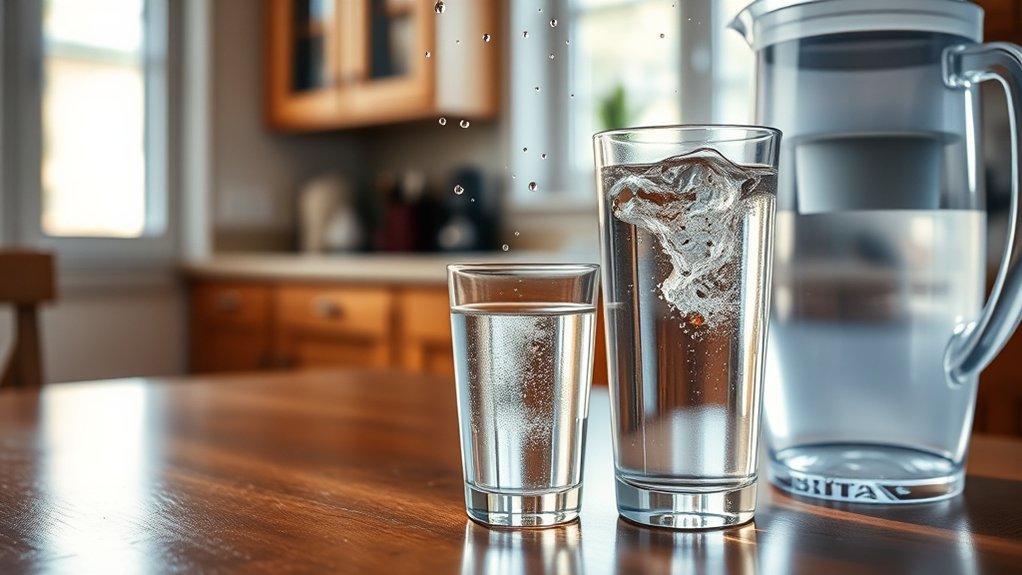
When you use a Brita water filter, you expect clearer, better-tasting water. Brita water filters effectively target chlorine and some organic compounds through activated carbon.
Ion-exchange resins in the filter reduce metals like lead and copper.
The filter also traps sediments and particulates with multi-layer filtration. However, its ability to remove bacteria, viruses, and certain heavy metals is limited. Understanding exactly what contaminants Brita handles—and which it doesn’t—can help you decide if it fits your needs.
Key Takeaways
- Brita filters primarily reduce chlorine taste and odor using activated carbon technology.
- They remove particulates such as sand, rust, and silt through multi-layer filtration.
- Ion-exchange resin in Brita filters reduces some heavy metals like lead and copper.
- Brita filters do not reliably remove bacteria, viruses, or other microbial contaminants.
- Filter effectiveness decreases after about 40 gallons or two months, requiring timely replacement.
What Contaminants Do Brita Filters Remove?
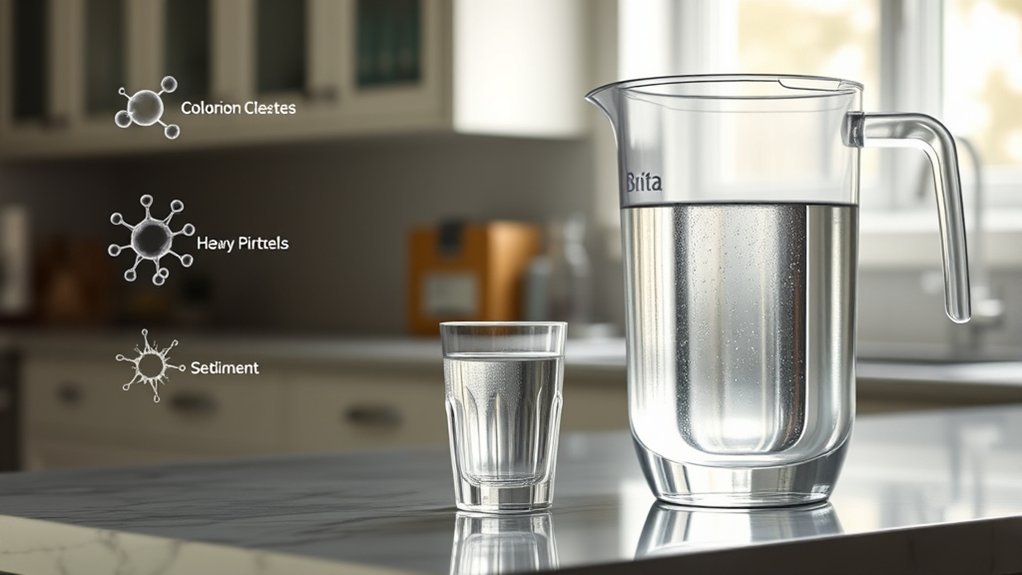
How effectively do Brita filters remove contaminants from your water? Brita filters offer a moderate contaminant breadth, targeting common impurities such as chlorine, mercury, copper, and cadmium. They employ activated carbon and ion-exchange resin to adsorb and reduce these substances efficiently.
However, their filtration scope doesn’t extend to all potential contaminants like bacteria or nitrates, so they’re not comprehensive for all water quality issues. The filter lifespan typically spans around 40 gallons or two months of usage, after which contaminant removal efficiency decreases notably.
To maintain optimal performance, you’ll need to replace the filter regularly. Overall, Brita filters deliver effective reduction for select chemical contaminants within their specified lifespan but don’t provide full-spectrum filtration for all waterborne impurities.
How Brita Filters Remove Chlorine to Improve Taste
Why does chlorine affect the taste of your water, and how does a Brita filter tackle this issue? Chlorine, used for disinfection, imparts a distinct, often unpleasant flavor and odor that degrades your drinking experience.
Brita filters employ activated carbon to adsorb chlorine molecules effectively, significantly improving Brita taste by removing these compounds before water reaches your glass. This adsorption process relies on the porous structure of activated carbon, which traps chlorine through chemical bonding.
To maintain optimal chlorine removal, you must perform weekly maintenance by replacing the filter cartridge as recommended. Neglecting this reduces filtration efficiency, allowing chlorine to pass through and compromise taste.
How Brita Filters Remove Heavy Metals Like Mercury
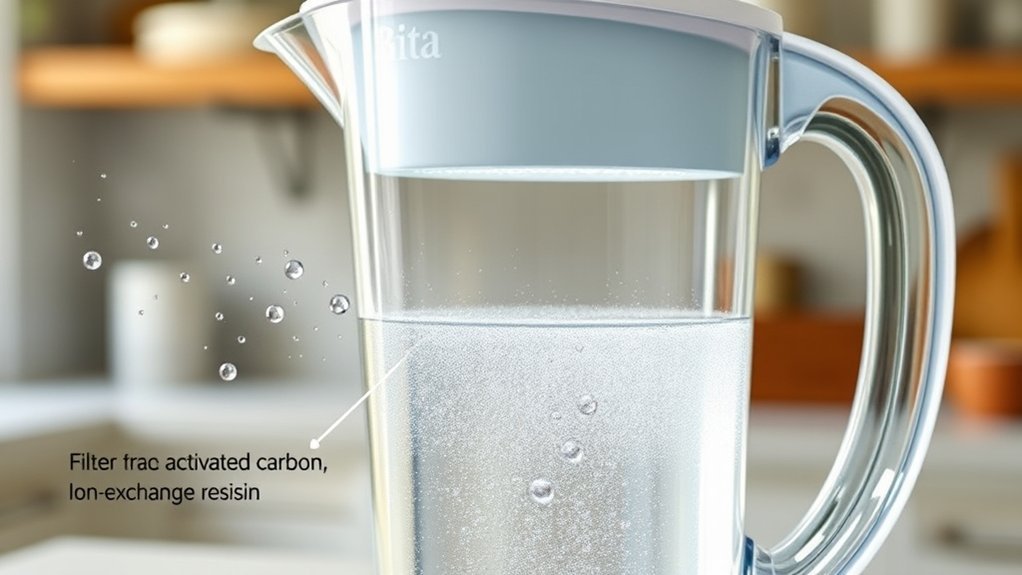
When dealing with heavy metals like mercury, Brita filters rely on ion exchange resin technology combined with activated carbon to reduce their presence in your drinking water. This dual mechanism enhances Brita efficacy by targeting metal ions through resin exchange and adsorbing organic compounds with carbon.
The metal interplay within the resin matrix ensures mercury ions are selectively captured, lowering contamination levels effectively.
| Component | Function | Target Contaminants |
|---|---|---|
| Ion Exchange Resin | Swaps harmful metal ions | Mercury, Lead, Cadmium |
| Activated Carbon | Adsorbs organic/inorganic | Mercury compounds, Chlorine |
| Resin Matrix | Metal interplay site | Heavy metal ions |
| Filter Media | Physical support | Sediments (secondary) |
| Flow Rate | Affects contact time | Influences removal efficacy |
This combination optimizes mercury reduction, ensuring safer water consumption.
How Brita Filters Trap Sediments and Particles
You’ll find that Brita filters effectively remove common sediments like rust, sand, and silt by using a combination of activated carbon and ion-exchange resin.
The filtration mechanism traps particles down to a specific micron size, ensuring clearer water. Understanding these details helps clarify how the filter maintains water quality by targeting physical contaminants.
Types Of Sediments Filtered
A Brita water filter effectively traps various sediments and particles that commonly contaminate tap water. Through sediment filtration and particle exclusion, it captures diverse particulate matter, improving water clarity and safety.
You’ll notice how it targets both coarse and fine sediments, preventing them from passing through.
| Sediment Type | Description |
|---|---|
| Sand | Coarse granules from soil erosion |
| Silt | Fine particles suspended in water |
| Rust Particles | Iron oxide flakes from pipes |
| Organic Debris | Plant and microbial fragments |
| Scale Residue | Mineral deposits from hard water |
This classification helps you understand the filter’s efficiency in removing sediments of varying sizes and compositions, ensuring optimized particle exclusion.
Filtration Mechanism Overview
Ensuring
Understanding how Brita filters trap sediments and particles reveals the precision behind its filtration process. The filter employs a multi-layered mechanism combining physical and chemical actions. First, sediment particles are physically trapped by a dense mesh designed to optimize Brita capacity without compromising flow rate.
This mesh captures larger debris, preventing clogging. Simultaneously, the filter chemistry involving activated carbon and ion-exchange resin addresses dissolved contaminants. The activated carbon adsorbs organic compounds, while the ion-exchange resin selectively binds heavy metals.
Together, these components ensure particles are not only physically blocked but also chemically neutralized. This dual approach maximizes filtration efficiency, maintaining consistent water quality throughout the filter’s lifespan while managing Brita capacity to prevent premature saturation or breakthrough of sediments and impurities.
Particle Size Removal
How exactly does a Brita filter trap sediments and particles of varying sizes? Brita filters rely on a carefully engineered pore structure to physically block contaminants based on size exclusion. The pores create a microscopic maze that particles cannot pass through if they exceed the threshold dimension.
When you pour water through a Brita filter, it captures:
- Suspended sediments like sand and rust particles
- Fine dirt and organic debris
- Microscopic particulates larger than the pore diameter
- Aggregates of compounds that form larger clusters
This multi-layered pore network ensures that particles ranging from visible grit to tiny suspended solids are effectively retained. By controlling pore size distribution, Brita filters provide reliable particle removal without significantly impeding water flow, enhancing both clarity and safety in your drinking water.
Do Brita Filters Remove Bacteria and Viruses?
Can Brita filters effectively remove bacteria and viruses from your water? The Brita filter efficiency primarily targets chlorine, particulates, and some heavy metals, but it has notable microbial limitations.
Its activated carbon and ion-exchange resin do not possess the pore size or antimicrobial mechanisms necessary to trap or inactivate microorganisms like bacteria or viruses. These microbes are substantially smaller than the filter’s physical barrier capabilities.
Consequently, while Brita filters improve taste and reduce chemical contaminants, they don’t provide reliable microbial purification. If your water source risks microbial contamination, you should consider additional treatment methods such as UV sterilization or reverse osmosis.
Relying solely on a Brita filter for bacterial or viral removal could expose you to health risks due to these inherent microbial limitations.
What Contaminants Brita Filters Do Not Remove
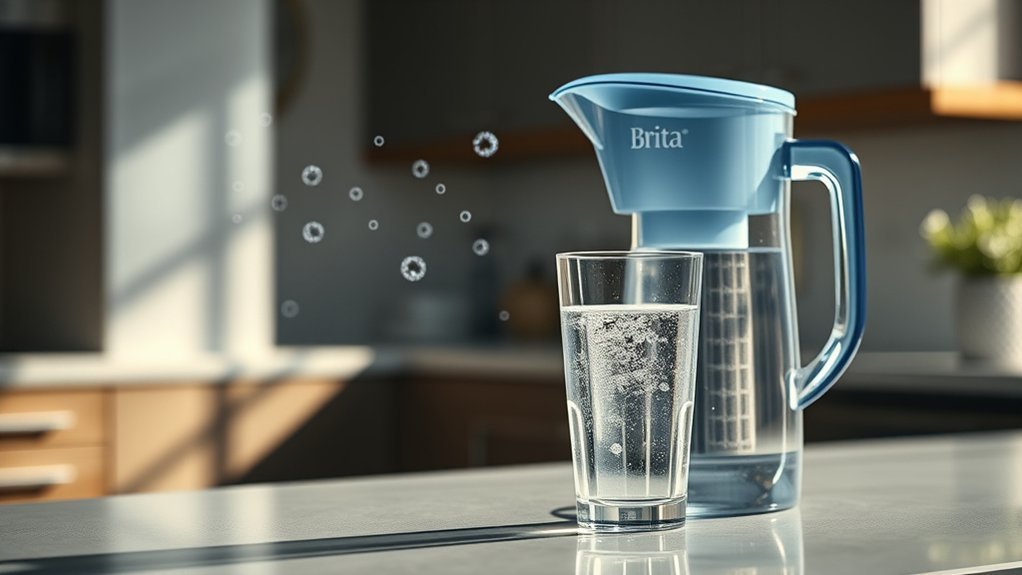
You should know that Brita filters have limitations when it comes to heavy metals like lead and mercury, as they don’t remove all types or concentrations effectively.
Additionally, these filters do not eliminate microbial contaminants such as bacteria and viruses. Understanding these exclusions helps you assess whether Brita meets your specific water purification needs.
Heavy Metals Limitations
Which heavy metals escape Brita filters, and why does this matter? Understanding Brita filter limitations is essential because certain heavy metals can persist in filtered water, impacting safety and taste.
Despite Brita’s activated carbon and ion-exchange resin, some metals aren’t fully removed, fueling the heavy metals debate on filter effectiveness. Metals that commonly bypass Brita filtration include:
- Lead in trace amounts, depending on water chemistry
- Arsenic compounds, especially organic forms
- Mercury variations resistant to adsorption
- Cadmium at low concentrations
These metals’ molecular forms and concentrations influence filter performance. You should recognize that Brita filters primarily reduce chlorine and particulates but don’t guarantee exhaustive heavy metal removal.
For heavy metal concerns, specialized filtration systems like reverse osmosis are recommended to ensure safety and compliance with health standards.
Microbial Contaminant Exclusion
How effectively do Brita filters handle microbial contaminants? Brita filters primarily focus on improving taste and reducing chlorine, heavy metals, and sediment. However, their design does not provide comprehensive microbial exclusion.
These filters lack the pore size and antimicrobial media necessary to remove bacteria, viruses, and protozoa effectively. As a result, relying on Brita for pathogen prevention isn’t advisable, especially in untreated or questionable water sources.
If microbial safety is a concern, you’ll need specialized filtration systems like UV purifiers or reverse osmosis units that specifically target microbial contaminants. In summary, while Brita filters improve water quality by reducing certain chemical impurities, they do not offer reliable microbial exclusion or pathogen prevention, so you should not depend on them for removing harmful microorganisms.
How to Tell When Your Brita Filter Needs Replacing
When does a Brita filter require replacement to maintain optimal performance? Understanding the filter lifespan and replacement timing is crucial for effective contaminant removal. Typically, Brita filters last about 40 gallons or two months, whichever comes first.
To determine if your filter needs replacing, watch for these indicators:
- Water flow rate slows significantly, signaling clogging.
- Taste or odor of filtered water changes, indicating reduced efficacy.
- The filter indicator or digital tracker signals end of lifespan.
- Visible discoloration or sediment buildup on the filter surface.
Monitoring these factors ensures you replace the filter promptly, maintaining the filtration system’s ability to reduce chlorine, heavy metals, and other contaminants efficiently. Timely replacement preserves water quality and protects your health.
How Brita Filters Compare to Other Home Water Filters
Why should you consider Brita filters over other home water filtration options? When comparing Brita vs. pitcher filters, Brita stands out for its consistent reduction of chlorine taste, odor, and certain heavy metals like lead and copper. Its activated carbon and ion-exchange resin technology delivers reliable contaminant removal, ensuring improved water quality.
In terms of Brita filter performance, independent tests confirm it meets NSF/ANSI standards 42 and 53, targeting aesthetic and health-related impurities. While other home filters, such as under-sink or reverse osmosis systems, may remove a broader spectrum of contaminants, Brita filters offer a cost-effective, user-friendly solution with quick filter replacements.
If your priority is convenience combined with proven filtration efficacy, Brita filters provide a balanced choice compared to many pitcher-based alternatives.
Frequently Asked Questions
How Often Should I Clean My Brita Pitcher?
You should clean your Brita pitcher every two weeks to maintain superior performance. Establish a cleaning schedule that includes washing the pitcher and lid with mild soap and water.
Ensure no mold or buildup affects filtration efficiency.
Can Brita Filters Be Used With Tap Water From Any Source?
You’ll appreciate Brita compatibility with most tap water sources, though water quality variations might cause filter flavor changes. Always check local water conditions to assure optimal filter performance and taste, maintaining precision in your hydration routine.
Are Brita Filters Safe for Use With Well Water?
You can use Brita POU filters with well water, but their effectiveness depends on your water’s specific contaminants. Testing well water first guarantees the filter handles your water quality safely and precisely for optimal results.
How Long Does It Take for Filtered Water to Taste Different?
You’ll notice taste change timing within minutes as the filter reduces chlorine and impurities.
Odor improvement occurs quickly, often after the first few filtered cups, enhancing water’s flavor and freshness with consistent use.
Can Brita Filters Be Recycled After Use?
You won’t believe it, but Brita filters can be recycled through specific recycling programs, reducing their environmental impact considerably. By participating, you guarantee precise disposal of activated carbon and plastics, promoting sustainability and minimizing landfill waste effectively.
Conclusion
You might think Brita filters turn your tap water into liquid gold, but don’t be fooled—they primarily tackle chlorine and some metals, not every contaminant lurking in your water. While they drastically improve taste and reduce sediments, they won’t banish bacteria or viruses.
So, if you expect a miracle purifier, you’ll be disappointed. Use Brita filters wisely, replacing them on time, and pair them with other solutions for truly exhaustive water safety.
Understanding what Brita water filter filter out helps you make better choices for your drinking water needs.