Are Heat Pump Water Heaters More Efficient Than Natural Gas
If you’re considering a new water heater, understanding whether heat pump water heaters are more efficient than natural gas units can substantially impact your energy use and costs.
Heat pump water heaters typically deliver a coefficient of performance (COP) between 2.5 and 3.5, far surpassing gas units with efficiencies around 0.6 to 0.7.
Yet, factors like climate, installation, and operational nuances can shift these numbers in surprising ways.
Taking these elements into account will help you make the best choice for your home and budget.
Key Takeaways
- Heat pump water heaters (HPWHs) have higher energy factors (EF 2.0–3.0) compared to natural gas models (EF 0.6–0.7), indicating greater efficiency.
- HPWHs use ambient air heat and electricity mainly for compressors, consuming about 50% less energy than electric storage heaters.
- Natural gas heaters combust methane directly, resulting in lower thermal efficiency (60–70%) and direct CO2 emissions.
- HPWH efficiency depends on climate, performing best in ambient temperatures above 40°F, while natural gas efficiency is less climate-dependent.
- Long-term cost savings with HPWHs are influenced by local electricity rates, incentives, and maintenance compared to fluctuating natural gas prices.
How Heat Pump Water Heaters Work Compared to Natural Gas Models
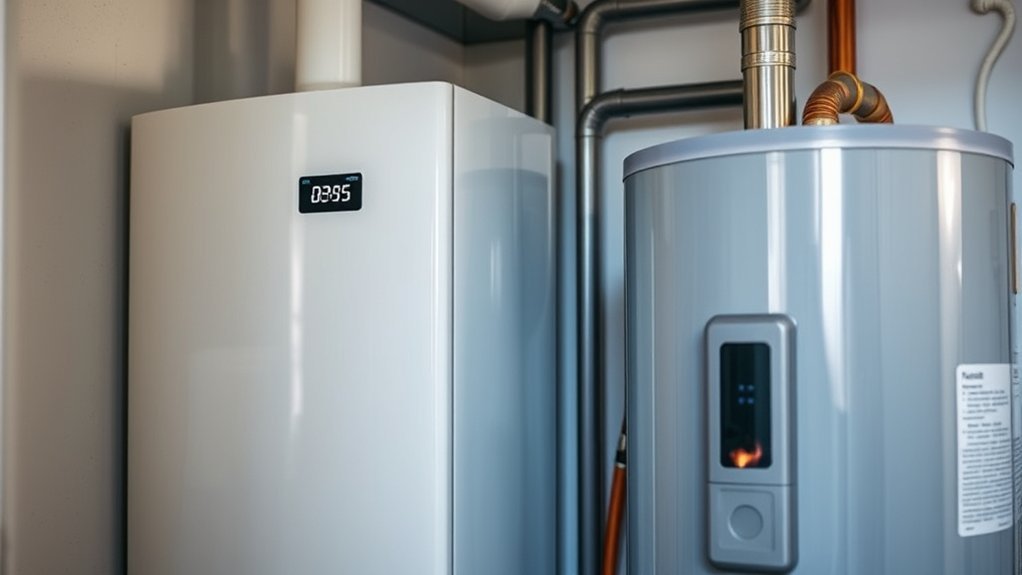
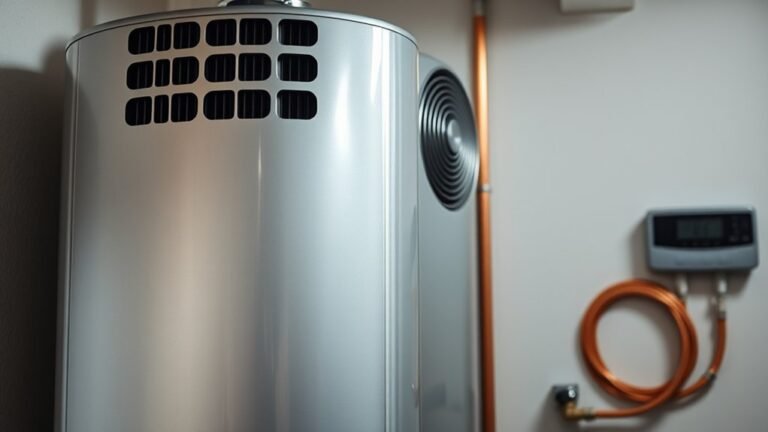
How exactly do heat pump water heaters differ from natural gas models in operation? You’ll find that heat pump water heaters extract ambient heat from the surrounding air and transfer it to water using a refrigeration cycle, consuming electricity primarily for the compressor and fans.
In contrast, natural gas heaters combust methane to generate heat directly. This operational difference drives their comparative efficiency: heat pumps typically achieve energy factors (EF) of 2.0 to 3.0, indicating they produce 2 to 3 units of heat per unit of electrical energy consumed, whereas natural gas models have an EF closer to 0.6 to 0.7.
From a climate impact standpoint, heat pumps can reduce greenhouse gas emissions since they rely on electricity, which can be sourced renewably, while natural gas combustion emits CO₂ directly.
How Does Climate Affect Heat Pump Water Heater Efficiency?
Why does climate play a critical role in the efficiency of heat pump water heaters? Because their performance depends on ambient air temperature, colder climates reduce heat extraction efficiency, leading to increased energy consumption.
Climate critically affects heat pump water heaters, as colder air lowers heat extraction efficiency and raises energy use.
You need to consider climate adaptation strategies, such as supplemental electric resistance heating or models optimized for low temperatures, to maintain efficiency in cold regions.
Additionally, the refrigerant lifecycle within the heat pump is sensitive to temperature variations; extreme cold can affect refrigerant pressure and flow, impacting heat transfer rates.
In warmer climates, heat pumps operate near peak efficiency, extracting ambient heat more effectively.
Therefore, when assessing heat pump water heater performance, you must factor in local climate conditions and the system’s ability to adapt, ensuring optimal refrigerant lifecycle management and sustained energy efficiency across temperature ranges.
Energy Efficiency: Heat Pumps vs. Natural Gas Water Heaters
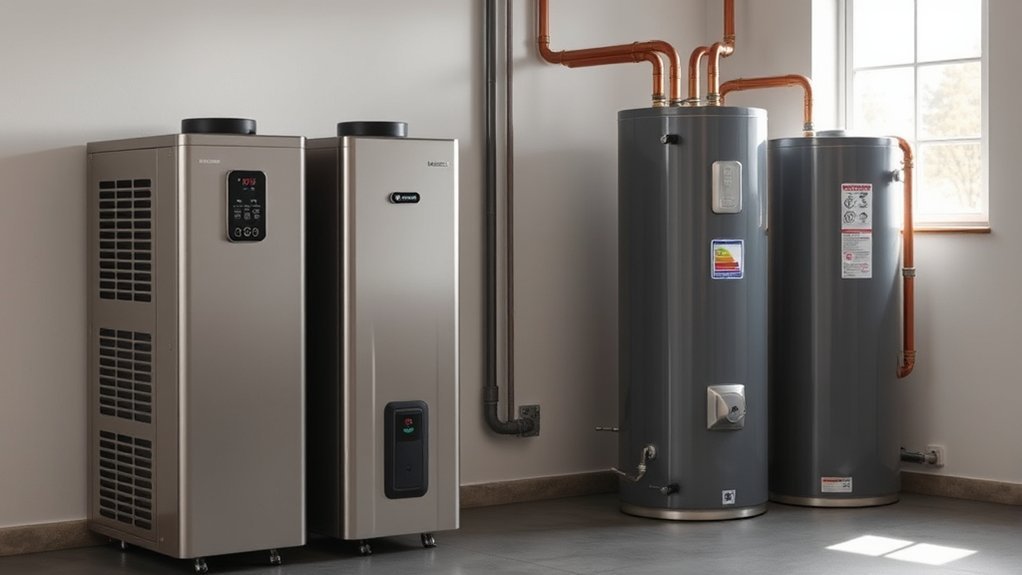
Understanding the impact of climate on heat pump water heater efficiency sets the stage for comparing their overall energy performance with natural gas water heaters. Heat pumps generally achieve a coefficient of performance (COP) between 2.5 and 3.5, meaning they produce 2.5 to 3.5 units of heat per unit of electricity consumed, outperforming natural gas units with typical thermal efficiencies around 0.6 to 0.7.
You should also consider heat pump noise, often around 50-60 dB, which could be noticeable indoors, unlike the quieter natural gas units. Installation space is another factor; heat pumps require more room due to their bulk and air circulation needs.
| Feature | Heat Pump Water Heater |
|---|---|
| Energy Efficiency | COP 2.5–3.5 |
| Noise Level | 50–60 dB |
| Installation Space | Larger, needs airflow clearance |
Which Water Heater Costs Less to Run? Operating Costs and Incentives
You’ll want to compare the energy consumption costs between heat pump and natural gas water heaters to determine which runs cheaper. Don’t forget to factor in available rebates and incentives that can lower your upfront expenses.
Evaluating long-term savings will give you a clearer picture of overall operating costs.
Comparing Energy Consumption Costs
How much will it actually cost to run a heat pump water heater compared to a natural gas model? Operating costs hinge on local energy tariffs: electric rates for heat pumps and natural gas prices for conventional units.
Heat pump water heaters typically consume 50% less energy, translating to lower monthly expenses if electricity rates are competitive. However, efficiency can be impacted by refrigerant leaks, which degrade performance and increase electricity use.
Natural gas water heaters incur steady costs influenced by fluctuating gas prices and require ventilation maintenance, affecting overall expenses. When calculating, you should factor in regional energy tariffs and potential efficiency losses.
In many cases, heat pumps prove more cost-effective, but your specific utility rates and system maintenance needs ultimately determine which water heater costs less to run.
Available Rebates And Incentives
Many homeowners can reduce the upfront cost of installing a heat pump water heater through available rebates and incentives offered by federal, state, and local programs. These financial incentives directly impact rebate uptake, making the transition more economically feasible.
You should monitor policy changes, as evolving regulations frequently expand or modify eligibility criteria and rebate amounts. For example, recent federal initiatives have increased maximum rebate values, encouraging higher adoption rates. Additionally, some states provide tiered rebates based on energy efficiency ratings or income levels, influencing your potential savings.
Long-Term Savings Analysis
When comparing long-term savings, which water heater truly costs less to run depends on several factors including energy source, efficiency, and local utility rates. In a cost comparison, heat pump water heaters (HPWHs) generally consume 50-60% less electricity than traditional electric models, translating to lower operating expenses.
However, natural gas units often benefit from lower fuel costs in certain regions. Maintenance tradeoffs also matter: HPWHs require periodic filter cleaning and may have higher initial service costs, while gas heaters need annual inspections to prevent combustion issues.
Additionally, available incentives can offset upfront costs, improving HPWH economic viability. Ultimately, your choice hinges on analyzing local energy prices, efficiency ratings, and maintenance demands to determine which system offers the best long-term operational value for your specific situation.
Installation Requirements and Space Considerations
You’ll need to evaluate available space carefully, as heat pump water heaters typically require more room for airflow and clearance than natural gas units.
Installation complexity varies depending on existing infrastructure, such as electrical capacity and venting requirements. Understanding these factors helps guarantee proper setup and peak performance.
Space Needs Assessment
Heat pump water heaters require careful space planning due to their larger footprint and need for adequate airflow compared to natural gas units. When assessing your space needs, consider these factors:
- Footprint: Heat pump units typically occupy 2-3 times more floor space, so measure your installation area precisely.
- Airflow Clearance: Maintain at least 1,000 cubic feet of surrounding air volume for efficient operation and heat exchange.
- Noise Considerations: Heat pumps generate 45-60 decibels; place units away from living or sleeping areas to minimize disturbance.
- Ventilation: Unlike natural gas heaters, heat pumps don’t require venting combustion gases but do need sufficient ventilation to dissipate extracted heat.
Installation Complexity Factors
How do installation requirements and space considerations impact the complexity of fitting a heat pump water heater compared to a natural gas unit? Heat pump water heaters demand more vertical clearance, typically 7 feet or more, due to the compressor and air circulation needs, complicating placement in confined areas.
You’ll also need adequate ventilation to optimize performance and manage noise considerations, as these units produce 50-60 decibels during operation, potentially affecting installation aesthetics in living spaces. In contrast, natural gas units are generally more compact and can fit into smaller, enclosed areas without ventilation concerns.
However, they require gas line connections and proper venting for combustion gases, adding complexity and safety considerations. Overall, you must balance space availability, noise impact, and visual integration when choosing between these systems for your installation.
Maintenance Needs for Heat Pump and Natural Gas Water Heaters
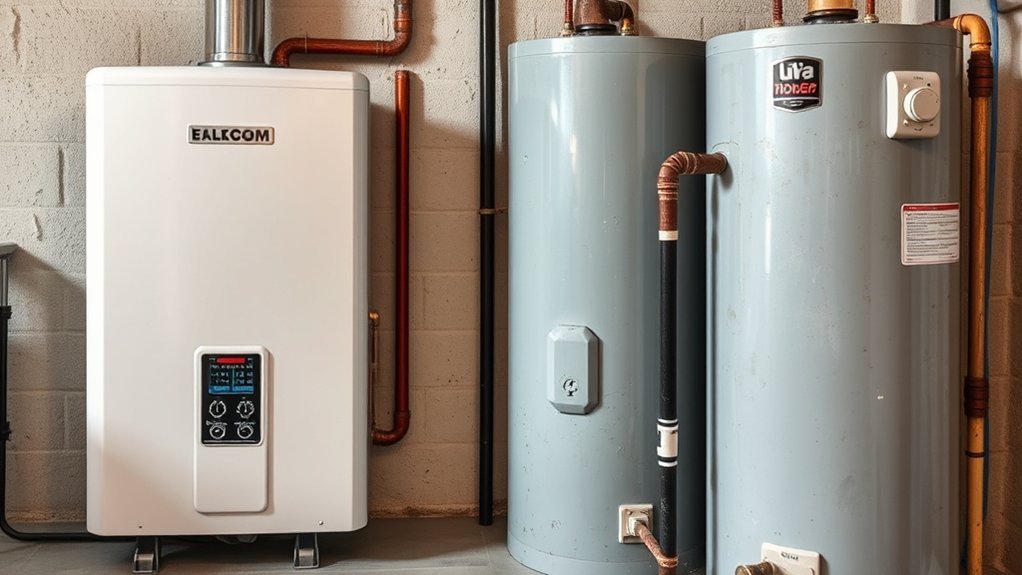
What maintenance tasks should you expect when owning either a heat pump or natural gas water heater? Both require periodic upkeep but differ in specifics. Heat pump models need regular filter cleaning to maintain efficiency, while natural gas units demand attention to venting considerations to ensure safe exhaust flow.
Here are key maintenance reminders for each:
- Inspect and clean heat pump air filters every 3-6 months.
- Flush tanks annually to remove sediment build-up.
- Check natural gas water heater vent pipes for blockages or corrosion.
- Test temperature-pressure relief valves yearly to prevent safety hazards.
Following these tasks helps optimize performance and prolongs unit lifespan. Staying proactive with maintenance reduces unexpected failures and supports energy efficiency in both systems.
Performance Differences: Heating Speed and Water Temperature Comparison
You’ll notice heat pump water heaters generally take longer to raise water temperature compared to natural gas units, which deliver faster heating cycles. However, heat pumps maintain more consistent temperature levels, reducing fluctuations during use.
Evaluating energy consumption during these heating phases reveals distinct efficiency profiles that impact overall performance.
Heating Speed Variations
When comparing heating speed, heat pump water heaters generally take longer to raise water temperature than natural gas models. You’ll notice this difference mainly stems from the mechanisms each uses to generate heat. Here’s a data-driven breakdown:
- Natural gas heaters typically heat water within 30-40 minutes due to direct combustion.
- Heat pump models require 1.5 to 3 hours because they transfer heat rather than generate it.
- Heating speed for heat pumps is influenced by ambient temperature; colder climates reduce efficiency.
- The climate impact is significant. Heat pumps perform best in moderate to warm environments, where their slower heating speed is offset by higher energy efficiency.
Understanding these heating speed variations helps you evaluate which system suits your needs and environment.
Temperature Consistency Levels
How consistent is the water temperature delivered by heat pump water heaters compared to natural gas models? Heat pump water heaters maintain steady temperatures due to advanced thermostatic controls, despite slower heating speeds.
Natural gas models heat water faster but exhibit minor temperature fluctuations under high demand. Considering pollution comparison, heat pumps reduce emissions, whereas gas units emit combustion byproducts. Noise levels also differ; heat pumps generate a low hum, while gas models produce brief ignition sounds.
| Feature | Heat Pump Water Heater |
|---|---|
| Temperature Consistency | ±1°F |
| Heating Speed | Slower |
| Pollution Comparison | Lower emissions |
| Noise Levels | Continuous low hum |
You’ll find heat pumps offer more uniform temperatures, optimizing comfort and efficiency.
Energy Use During Heating
Beyond temperature consistency, energy consumption during the heating process substantially impacts overall efficiency. When comparing heat pump water heaters (HPWHs) to natural gas units, you’ll notice distinct performance differences in heating speed and water temperature maintenance.
To optimize energy use, consider these factors:
- HPWHs consume less energy by extracting ambient heat but heat water slower than gas units, affecting heating speed.
- Natural gas heaters deliver rapid heating but often at lower overall efficiency due to combustion losses.
- Energy policy increasingly favors HPWH adoption, incentivizing reduced carbon footprints in residential and commercial sectors.
- Effective workforce training is critical to installing and maintaining HPWHs, ensuring optimal energy performance and compliance with evolving regulations.
Understanding these aspects helps you evaluate efficiency trade-offs accurately when choosing between these technologies.
Environmental Impact of Heat Pump and Natural Gas Water Heaters
Why does the environmental impact of water heaters matter to you? Because your choice influences greenhouse gas emissions and resource consumption. Heat pump water heaters offer significant environmental tradeoffs compared to natural gas models.
Your water heater choice impacts greenhouse gas emissions and resource use, shaping your environmental footprint.
They use electricity, which can be sourced increasingly from renewables, reducing carbon emissions by up to 50-60% versus natural gas units. However, heat pumps generate noise, typically around 50-60 decibels, which you should consider if installed near living spaces.
Natural gas heaters emit CO2 directly during combustion and depend on fossil fuels, contributing more to climate change. Additionally, methane leaks in natural gas infrastructure pose extra environmental risks.
Evaluating these factors helps you balance energy efficiency with environmental responsibility, ensuring your water heater choice aligns with your sustainability goals while addressing noise considerations effectively.
Incentives and Rebates for Heat Pump Water Heaters Explained
Where can you find financial support to offset the upfront cost of a heat pump water heater? A detailed analysis reveals several key incentives and rebates designed to encourage adoption and address misconceptions about initial expenses.
These programs can substantially reduce your costs:
- Federal tax credits, offering up to 30% of the purchase price.
- State and local utility rebates, varying by region and provider.
- Energy efficiency grant programs targeting residential upgrades.
- Manufacturer discounts or bundled installation offers.
Understanding these options is essential, as many assume heat pump water heaters lack financial support, which is inaccurate. This objective, data-driven overview helps you navigate available incentives effectively, maximizing economic benefits and improving the cost-efficiency of your investment.
Which Water Heater Is Best for Your Home: Heat Pump or Natural Gas?
After considering the financial incentives that can reduce the upfront cost of heat pump water heaters, the next logical step is evaluating which type of water heater aligns best with your home’s needs. Heat pump water heaters typically offer higher energy efficiency, with a coefficient of performance (COP) ranging from 2.5 to 3.5, compared to natural gas units averaging an energy factor (EF) around 0.6 to 0.7.
However, climate and installation space influence performance significantly. For example, heat pumps require ambient air temperatures above 40°F to operate optimally, making them less effective in colder regions. Avoid irrelevant topics or random comparisons unrelated to efficiency and cost metrics.
Frequently Asked Questions
Can Heat Pump Water Heaters Connect to Smart Home Systems?
Yes, heat pump water heaters often offer integration compatibility with smart home systems, enabling you to optimize performance. They support energy monitoring features, helping you track usage data and manage efficiency through connected devices and apps.
Are Heat Pump Water Heaters Noisy During Operation?
You might notice a faint hum coinciding with your HVAC system, but heat pump water heaters feature quiet operation and effective noise mitigation.
Technical data shows sound levels typically range between 40-60 decibels, comparable to a quiet conversation.
What Is the Typical Lifespan of a Heat Pump Water Heater?
You can expect a heat pump water heater to last about 10-15 years. Its lifecycle cost benefits depend on regular maintenance needs, like cleaning filters and coils, ensuring efficient operation and prolonging its lifespan effectively.
Do Heat Pump Water Heaters Require Special Electrical Upgrades?
Don’t worry about costly special electrical upgrades; most heat pump water heaters run on standard 240V circuits.
Plus, their smart home integration options let you monitor energy use efficiently, optimizing performance with data-driven controls.
Can Heat Pump Water Heaters Be Used in Off-Grid Homes?
You can use heat pump water heaters in off-grid homes, but off-grid viability depends on sufficient battery capacity to handle their electrical demand.
Proper battery considerations ensure consistent operation without grid reliance or power interruptions.
Conclusion
When choosing between heat pump and natural gas water heaters, you’ll find heat pumps typically deliver 50% lower operating energy with EF values around 2.0–3.0, far outperforming gas models at 0.6–0.7. While climate and installation affect efficiency, heat pumps shine in warmer areas and cut CO2 emissions substantially.
In the long run, they often cost less to run, especially with incentives—proving that putting your money where your mouth is can lead to smarter, greener energy use. Heat pump water heaters are more efficient than natural gas models, making them a sustainable choice for the future.