Are Heat Pump Water Heaters Efficient
You might think heat pump water heaters are just another expensive gadget, but their efficiency tells a different story. Heat pump water heaters work by transferring ambient heat rather than generating it directly. This allows them to achieve coefficients of performance (COP) between 2.0 and 3.5, slashing electricity use by up to 75% compared to traditional resistance heaters.
Yet, their true performance depends on factors you may not expect. Understanding these can reveal significant savings and environmental benefits.
Key Takeaways
- Heat pump water heaters use 60-75% less electricity than traditional electric resistance models due to their efficient heat transfer process.
- They achieve a coefficient of performance (COP) between 2.0 and 3.5, meaning they deliver 2 to 3.5 units of heat per unit of electricity.
- Optimal efficiency occurs in spaces with ambient temperatures between 40°F and 90°F, such as basements or utility rooms with good airflow.
- High Energy Factor (EF) or Uniform Energy Factor (UEF) ratings reflect true energy savings and superior performance of modern heat pump models.
- Over their lifecycle, heat pump water heaters reduce greenhouse gas emissions by about 50%, offering significant environmental and cost benefits.
How Do Heat Pump Water Heaters Work Differently?
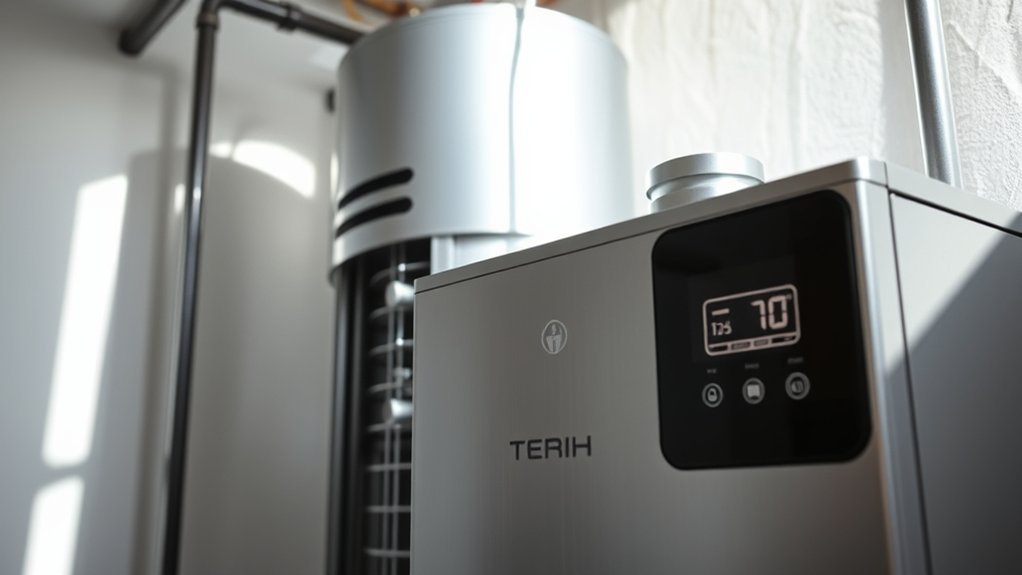
How exactly do heat pump water heaters differ in operation from traditional models? Unlike conventional water heaters that generate heat through electric resistance or gas combustion, heat pump water heaters transfer heat from the surrounding air to the water using a refrigeration cycle.
This mechanism involves a refrigerant circulating through an evaporator coil, absorbing ambient heat, then compressing it to a higher temperature before transferring it to the water in the tank. As a result, the heat pump water heater consumes significantly less electrical energy to heat water.
You’ll note that this process requires ambient air temperatures typically between 40°F and 90°F to operate efficiently, which contrasts with the direct heating element in traditional models. This fundamental operational difference defines the heat pump water heater’s unique energy profile.
How Efficient Are Heat Pump Water Heaters Compared to Traditional Models?
You’ll notice heat pump water heaters use about 50% less energy than traditional electric models, markedly cutting your operational costs. When comparing lifecycle expenses, the initial higher investment pays off through lower utility bills over time.
Plus, their reduced energy consumption directly translates to a smaller carbon footprint, benefiting the environment.
Energy Consumption Differences
Why do heat pump water heaters consume markedly less energy than traditional electric resistance models? They extract ambient heat and transfer it to water, achieving a coefficient of performance (COP) between 2.5 and 3.5, meaning they use 60-75% less electricity.
In contrast, electric resistance heaters convert electricity directly to heat at nearly 100% efficiency but without amplification. When evaluating energy consumption differences, don’t get distracted by novelty focus or irrelevant comparisons, such as contrasting heat pumps with gas heaters or solar systems, which have distinct mechanisms and energy sources.
Instead, focus on kilowatt-hours consumed per gallon heated. Empirical data consistently show heat pump water heaters reduce electrical energy requirements substantially, making them a superior choice for energy-conscious consumers aiming to cut consumption without compromising performance.
Operational Cost Comparison
When comparing operational costs between heat pump water heaters and traditional electric resistance models, what stands out is the significant reduction in electricity expenses due to higher efficiency. Heat pumps typically use 60-70% less electricity, translating to annual savings of $300-$500 depending on your local rates.
To maximize these savings, an efficient pairing with an appropriately sized water heater and optimal installation location is critical, as this affects both performance and noise considerations. Heat pumps generate some operational noise, unlike silent resistance models, so factoring in noise levels in your space is essential.
Environmental Impact Benefits
How much can switching to a heat pump water heater reduce your environmental footprint? Studies show these units cut greenhouse gas emissions by approximately 50% compared to traditional electric resistance models.
This reduction stems from their superior energy efficiency, often achieving a Coefficient of Performance (COP) of 3.0 or higher, meaning they produce three units of heat per unit of electricity consumed. When evaluating lifecycle impact, including manufacturing, operation, and disposal, heat pump water heaters consistently demonstrate lower total emissions.
Though initial production may involve more energy-intensive components, the significant operational savings outweigh these factors within 1-2 years of use. By choosing a heat pump system, you effectively reduce both your direct energy consumption and the broader environmental footprint associated with water heating, making it a technically sound and environmentally responsible choice.
How Much Can a Heat Pump Water Heater Save You?
You can expect a heat pump water heater to reduce your energy consumption by 50-60% compared to traditional electric models. Over its lifespan, these savings translate into considerably lower utility bills and a faster return on your initial investment.
Analyzing your local energy rates and usage patterns will help quantify the long-term cost benefits specific to your situation.
Energy Savings Potential
Exactly how much can a heat pump water heater reduce your energy bills? On average, it uses 50-60% less electricity than conventional electric water heaters. This translates into significant savings, depending on your household size and electricity rates.
Unlike an unrelated topic like random trivia, this data directly impacts your monthly expenses.
| Household Size | Annual Energy Savings (kWh) | Estimated Cost Savings ($) |
|---|---|---|
| 2 persons | 1,500 | 180 |
| 4 persons | 3,000 | 360 |
| 6 persons | 4,500 | 540 |
These figures are based on typical U.S. energy costs. Your actual savings depend on usage patterns and local rates.
Long-Term Cost Benefits
When evaluating the long-term cost benefits of a heat pump water heater, consider both the upfront investment and cumulative energy savings over time. Although heat pump water heaters typically cost 40-60% more upfront than conventional units, their superior efficiency, often 2 to 3 times that of electric resistance heaters, translates into significant energy cost reductions.
Data shows that households can save approximately $300 to $500 annually on water heating bills, depending on usage and local electricity rates. Over a 10-15 year lifespan, these savings can offset the higher initial expense, resulting in net financial gains.
Additionally, many regions offer rebates or incentives, further improving return on investment. By switching to a heat pump water heater, you can achieve measurable long-term cost benefits through sustained energy efficiency and reduced utility expenses.
What Are the Best Home Conditions for Heat Pump Water Heaters?
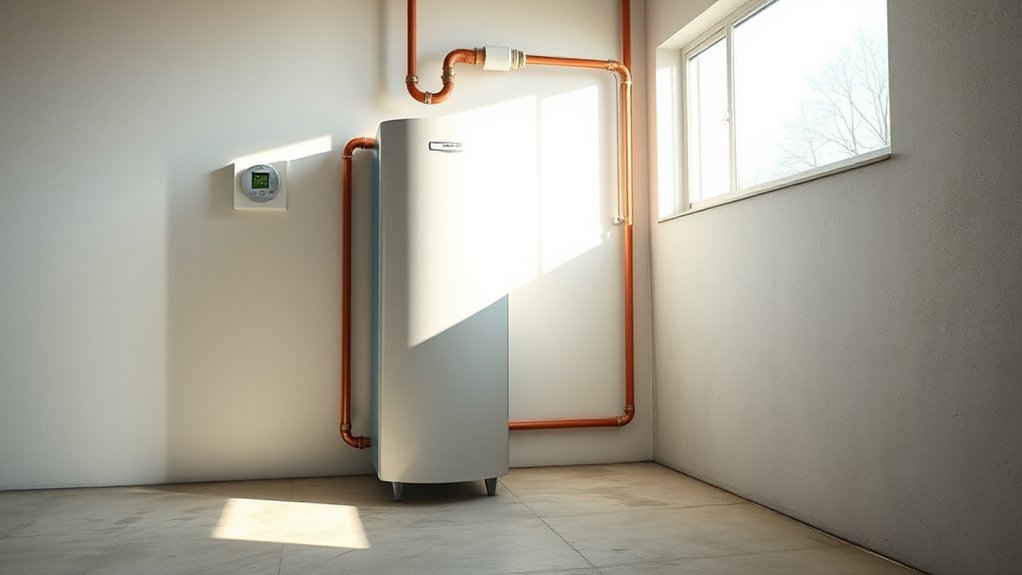
Where do heat pump water heaters perform most efficiently? Their optimal operation depends heavily on appliance placement and debunking common energy myths. You want a location that maintains a consistent temperature between 40°F and 90°F, ideally within a conditioned space.
Avoid spots prone to extreme cold or heat, as this reduces efficiency. Proper placement also ensures effective heat absorption from surrounding air, maximizing energy transfer.
Consider these factors for best performance:
- Install in a basement, utility room, or garage with stable temperatures
- Ensure at least 1,000 cubic feet of air volume around the unit
- Avoid tight closets or outdoor exposure without temperature control
- Minimize airflow obstructions to optimize heat exchange
What Affects Heat Pump Water Heater Efficiency?
Proper placement sets the stage, but several technical and environmental factors ultimately determine how efficiently a heat pump water heater operates. You must avoid improper installation and incorrect voltages, as these reduce performance and can cause premature failure.
Ambient temperature, humidity, and airflow around the unit also play crucial roles. Lower ambient temperatures decrease coefficient of performance (COP), while restricted airflow limits heat extraction. You should monitor electrical supply stability to maintain optimal operation.
| Factor | Impact on Efficiency | Notes |
|---|---|---|
| Installation Quality | High impact | Improper installation lowers COP |
| Voltage Accuracy | Critical | Incorrect voltages cause energy loss |
| Ambient Temperature | Medium | Efficiency drops below 50°F |
| Airflow | Medium | Restricted airflow reduces heat transfer |
| Humidity | Low to medium | Higher humidity can improve heat extraction |
How to Choose the Right Heat Pump Water Heater
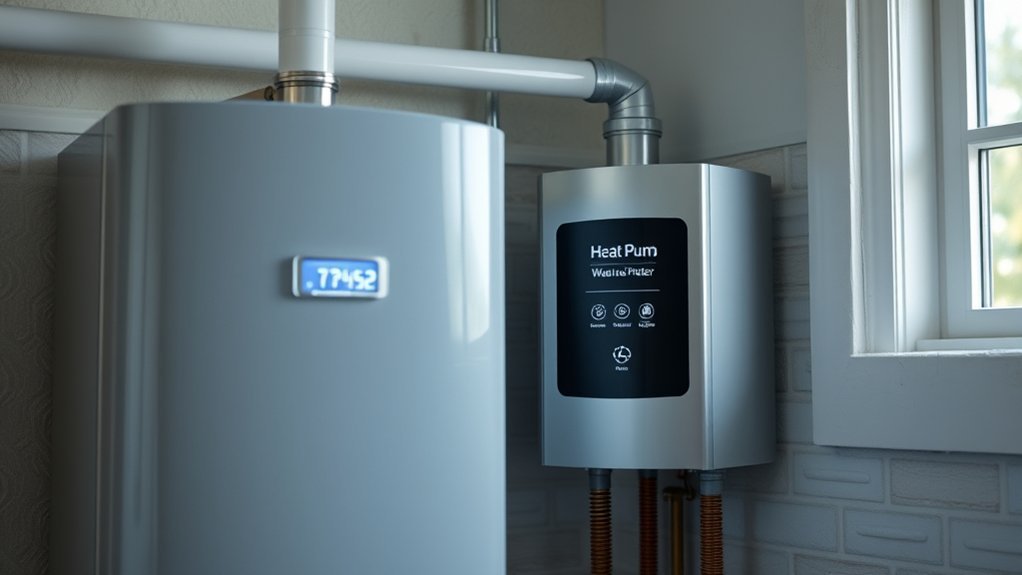
How do you determine which heat pump water heater best fits your needs? Start by analyzing your household’s hot water demand and space constraints. Don’t fall for common efficiency myths; instead, focus on the unit’s Energy Factor (EF) or Uniform Energy Factor (UEF) ratings to assess true performance.
Installation myths often lead to improper placement, so ensure your chosen model suits your available space and ventilation options. Consider these critical factors:
- Capacity: Match the heater’s gallon size to your peak water usage.
- Efficiency Ratings: Prioritize units with high UEF to optimize energy savings.
- Installation Requirements: Verify space, airflow, and climate compatibility to avoid efficiency loss.
- Cost vs. Savings: Evaluate upfront costs against long-term energy reductions.
Common Myths About Heat Pump Water Heater Efficiency
Why do so many misconceptions persist about heat pump water heater efficiency? The myth vs reality gap stems from outdated data and misunderstanding of operational parameters.
One common efficiency myth claims heat pump water heaters perform poorly in cold climates. However, modern units maintain 2.0 to 3.0 coefficient of performance (COP) even at ambient temperatures as low as 40°F, according to recent tests.
Modern heat pump water heaters sustain high efficiency with COP of 2.0 to 3.0 even at 40°F.
Another myth suggests high upfront costs negate energy savings. Yet, lifecycle cost analyses demonstrate payback periods under seven years in most U.S. regions.
Some believe heat pumps deliver inconsistent hot water, but advanced control algorithms and insulated tanks ensure stable temperature output.
Frequently Asked Questions
How Long Do Heat Pump Water Heaters Typically Last?
You can expect a heat pump water heater’s operating lifespan to range between 10 and 15 years, balancing short term durability with efficiency. Regular maintenance extends this period, ensuring reliable performance throughout its technical lifecycle.
Are Heat Pump Water Heaters Noisy During Operation?
Oh sure, heat pump water heaters roar louder than a jet engine said no data ever. You’ll find noise concerns mostly exaggerated; these units run quietly, efficiently debunking noise myths while delivering top-tier performance with minimal sound output.
Can Heat Pump Water Heaters Be Installed in Cold Climates?
You can install heat pump water heaters in cold climates, but their cooling role and efficiency drop as temperature impact increases. Performance decreases considerably below 40°F, requiring supplemental heating to maintain optimal water temperature consistently.
What Maintenance Is Required for Heat Pump Water Heaters?
You’ll need to perform maintenance basics like cleaning filters and checking refrigerant levels regularly. Avoid installation pitfalls such as poor ventilation, which can reduce efficiency and increase wear, ensuring optimal performance and longevity.
Do Heat Pump Water Heaters Qualify for Tax Rebates or Incentives?
Yes, heat pump water heaters often qualify for rebate eligibility under federal and state incentive programs.
You should analyze local policies and utility offers to maximize financial benefits, as qualification criteria and rebate amounts vary considerably across regions.
Conclusion
You can cut your electricity use by up to 75% with a heat pump water heater compared to traditional electric resistance models. This impressive efficiency stems from transferring ambient heat rather than generating it directly, achieving COP values often between 2.5 and 3.5.
To maximize savings, install it in a conditioned space with good airflow and ensure proper sizing. Understanding these factors helps you confidently choose a system that delivers strong long-term performance and cost-effectiveness.
Considering these points will help you make an informed decision and enjoy the benefits of a highly efficient heat pump water heater.