Are Heat Pump Water Heaters More Efficient Than Gas
You might not realize that heat pump water heaters are more efficient than gas models, achieving efficiency ratings three times higher than traditional gas units. Their Uniform Energy Factors (UEFs) often exceed 3.0, while gas water heaters typically range around 0.6 to 0.7.
This significant difference comes from their ability to move heat rather than generate it directly. But how does this translate into real-world energy savings and operating costs for your home?
Key Takeaways
- Heat pump water heaters typically achieve a Uniform Energy Factor (UEF) of 3.0 or higher, outperforming gas models averaging 0.6 to 0.7.
- Heat pumps transfer ambient heat using a refrigeration cycle, consuming at least three times less energy than gas water heaters.
- Coefficients of Performance (COP) for heat pumps range from 2.5 to 3.5, indicating efficiencies exceeding 300% compared to gas units’ 60-70%.
- Heat pumps produce 50-70% fewer greenhouse gas emissions than gas water heaters, especially when paired with renewable electricity.
- Heat pump efficiency is optimal in moderate climates above 40°F, providing greater long-term energy savings and lower operating costs.
Heat Pump vs Gas Water Heaters: Which Is More Efficient?
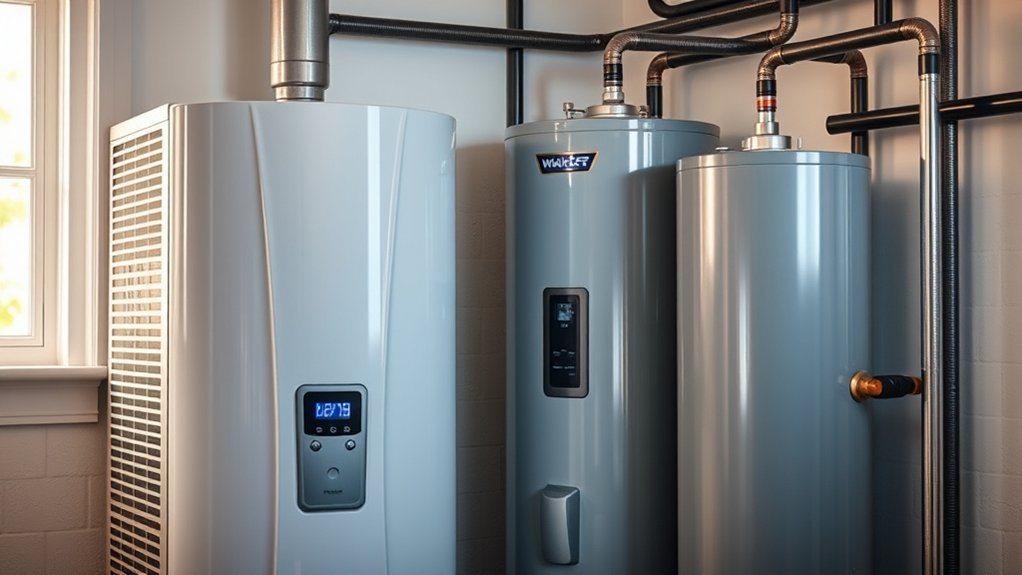
How do heat pump water heaters stack up against gas models in efficiency? Heat pump water heaters typically achieve a Uniform Energy Factor (UEF) of 3.0 or higher, compared to gas models averaging around 0.6 to 0.7 UEF. This indicates heat pumps use at least three times less energy to produce the same amount of hot water.
Energy labeling on heat pumps reflects this superior efficiency, making it easier for you to assess long-term energy savings. Additionally, heat pump water heaters often come with extended warranty coverage, commonly 10 years, versus the shorter warranties, usually 6 years, on gas units.
These factors combine to enhance reliability and reduce operational costs. While initial costs may be higher for heat pumps, their energy efficiency and robust warranty coverage typically justify the investment over gas alternatives.
How Heat Pump Water Heaters Work Compared to Gas Water Heaters
Why do heat pump water heaters consume markedly less energy than gas models? Unlike gas units that combust fuel to generate heat directly, heat pump water heaters transfer ambient heat from the surrounding air to the water using a refrigeration cycle. This method requires significantly less electrical input, achieving efficiencies often exceeding 300% compared to gas water heaters’ typical 60-70%.
When considering installation, you must navigate environmental policy constraints and local permit requirements, which often favor heat pump systems due to their reduced greenhouse gas emissions. Gas water heaters involve combustion venting and stricter safety codes, increasing regulatory complexity.
Understanding these operational and regulatory differences helps you evaluate which technology aligns with your energy goals and compliance needs, especially in jurisdictions prioritizing sustainability through updated environmental policies.
Why Heat Pump Water Heaters Use Less Energy
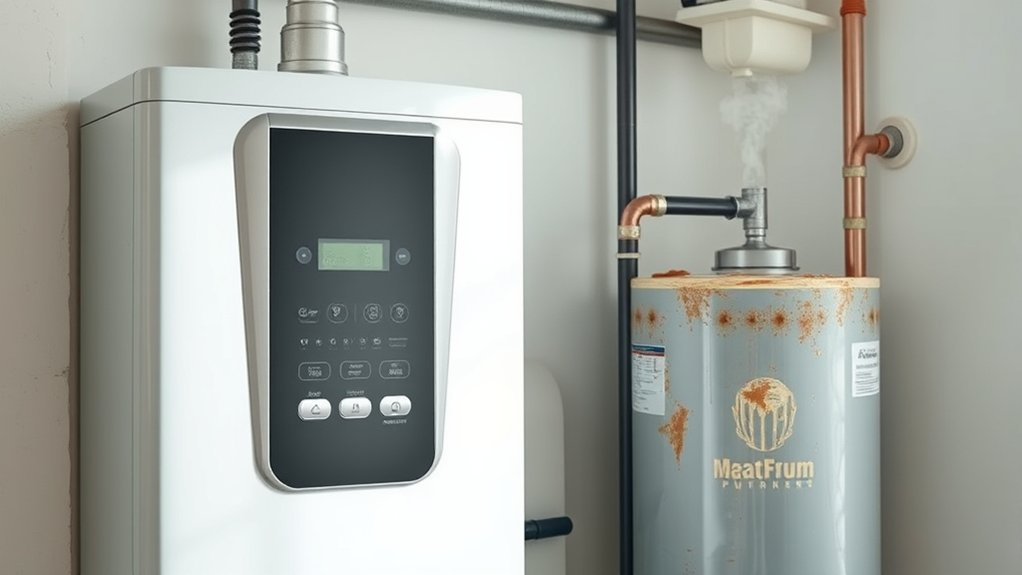
The significant difference in energy consumption between heat pump and gas water heaters stems from their fundamental mechanisms of heat generation. Heat pump water heaters transfer ambient heat using a refrigeration cycle, consuming roughly 50-60% less electricity than the energy gas water heaters require to combust fuel and generate heat directly.
This efficient heat transfer debunks the myth that heat pumps are noisy and energy-intensive; modern units operate at sound levels comparable to a quiet refrigerator, addressing noise concerns effectively. Furthermore, heat pumps maintain higher Coefficients of Performance (COP), often between 2.5 and 3.5, meaning they deliver 2.5 to 3.5 units of heat per unit of electricity consumed.
Operating Costs: Heat Pump Versus Gas Water Heaters
You’ll find that heat pump water heaters consume substantially less energy than gas models, which directly impacts your monthly utility bills. However, maintenance and repair costs differ; gas units often require more frequent servicing due to combustion components.
Comparing these expenses side-by-side helps determine the true operating cost over the heater’s lifespan.
Energy Consumption Comparison
How do heat pump water heaters stack up against gas models when it comes to energy consumption? Heat pump water heaters use electricity to transfer heat rather than generate it directly, resulting in 2 to 3 times greater energy efficiency compared to gas heaters.
For example, a heat pump typically has a coefficient of performance (COP) around 3.0, meaning it produces three units of heat per unit of electricity consumed. Conversely, gas water heaters convert fuel at about 60-70% efficiency. This translates to markedly lower operating energy costs for heat pumps over time.
However, you should also weigh noise considerations, as heat pumps emit low-level operational sounds, unlike silent gas units. While repair costs fall outside this scope, energy consumption clearly favors heat pumps, especially where electricity rates are competitive with gas prices.
Maintenance and Repair Expenses
When comparing maintenance and repair expenses, which water heater type demands less from your budget over time? Heat pump water heaters require more proactive maintenance scheduling due to their complex components, such as compressors and fans. This can increase annual upkeep costs by approximately 15-20% compared to gas models.
Gas water heaters, while simpler, often face higher repair costs tied to burner or venting system failures. For repair budgeting, anticipate that heat pump units may incur costs averaging $200-$300 per service event, whereas gas units typically range from $150-$250.
However, heat pump water heaters benefit from longer maintenance intervals if well-managed. Ultimately, your maintenance scheduling precision and repair budgeting discipline will determine the total operating cost efficiency between these systems over their lifespan.
When Do Heat Pump Water Heaters Save You the Most Money?
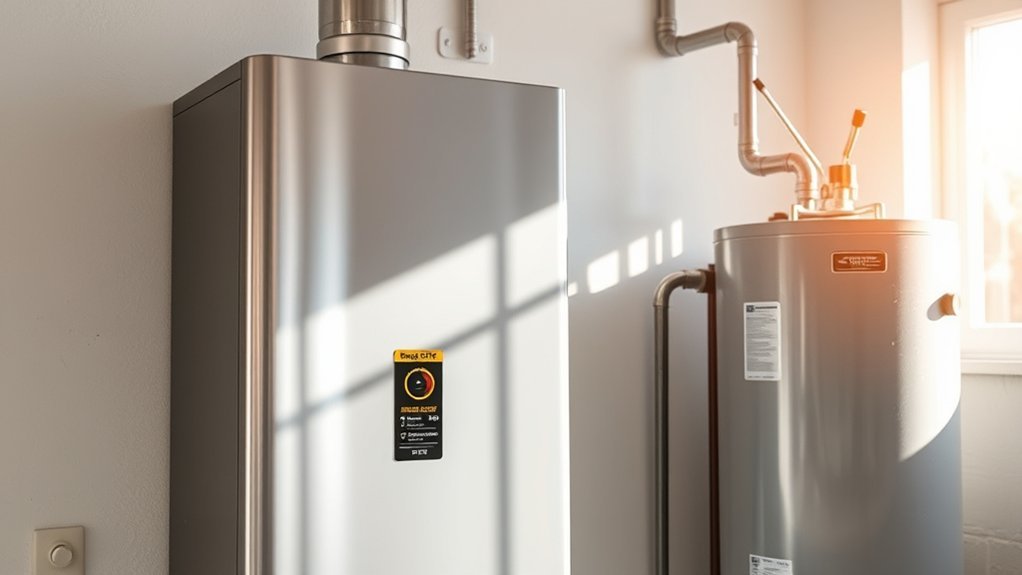
You save the most money with heat pump water heaters in moderate to warm climates where ambient air temperatures stay above 40°F year-round.
Your daily hot water usage also affects savings, as higher demand maximizes the unit’s efficiency advantage over gas models. Understanding these factors helps you estimate when a heat pump water heater will reduce your energy costs considerably.
Optimal Climate Conditions
Where do heat pump water heaters deliver the greatest efficiency gains? They perform best in moderate to warm climates, typically between 40°F and 90°F ambient temperatures. In these conditions, the heat pump extracts thermal energy efficiently, reducing electricity consumption compared to traditional electric resistance or gas water heaters.
You’ll also benefit from enhanced gas safety since you avoid combustion-related risks inherent in gas systems. From a water heating chemistry perspective, stable ambient temperatures help maintain consistent water temperature profiles, minimizing scaling and corrosion rates inside the tank.
Conversely, in colder climates, efficiency drops as the heat pump must work harder, sometimes requiring backup electric resistance heating. So, if your local climate stays mostly warm, you’ll maximize savings and safety with a heat pump water heater.
Usage Patterns Impact
How does your daily water usage affect the cost savings of a heat pump water heater? Usage patterns strongly influence efficiency, as heat pump water heaters rely on extracting ambient heat, making timing and volume critical.
Consider these two word discussion ideas to maximize savings:
- Peak Usage: Running hot water during off-peak hours can reduce electricity costs and enhance heat pump efficiency.
- Volume Demand: Consistent, moderate water use ensures steady heat extraction, avoiding energy spikes from large, irregular demands.
- External Variables: Ambient temperature and humidity impact heat pump performance, so your local climate and household schedule play key roles.
Environmental Impact: Which Water Heater Is Greener?
When comparing the environmental impact of heat pump water heaters and gas models, which option truly offers a greener solution? Heat pump water heaters generally produce 50-70% fewer greenhouse gas emissions than gas units due to their reliance on electricity, especially when paired with renewable energy sources.
Gas water heaters combust fossil fuels, emitting CO2 and other pollutants directly. In evaluating their role within office design, heat pump systems contribute less to indoor air quality degradation, enhancing indoor acoustics by operating quietly compared to gas models that generate combustion noise.
Additionally, heat pumps avoid methane leaks associated with natural gas extraction and delivery, which have a high global warming potential. Thus, if you prioritize reducing carbon footprint and improving indoor environmental quality, heat pump water heaters present a technically superior, greener choice over gas alternatives.
Installation Needs for Heat Pump and Gas Water Heaters
When installing a heat pump water heater, you’ll need ample space, typically at least 1,000 cubic feet of air volume, and a dedicated 240-volt electrical circuit. Gas water heaters require proper ventilation to expel combustion gases and usually connect to existing gas lines.
Understanding these spatial, ventilation, and electrical demands will help you choose the most practical option for your home.
Space Requirements
Where you install your water heater considerably impacts both performance and maintenance. When comparing heat pump and gas water heaters, space requirements are critical and often misunderstood, focusing on irrelevant topics like aesthetic placement is a red herring.
Consider these three key points:
- Heat pump water heaters need at least 1,000 cubic feet of surrounding air space for efficient heat exchange, requiring more room than gas units.
- Gas water heaters occupy less floor space but demand clearance around vents and combustion areas, typically 18–24 inches.
- Accessibility for routine maintenance and emergency shutoff must be factored into your spatial planning to comply with safety codes.
Ventilation and Electrical Needs
How do ventilation and electrical requirements differ between heat pump and gas water heaters? Gas water heaters demand specific ventilation nuances to safely expel combustion gases. You must install vent pipes compliant with local codes to prevent carbon monoxide buildup.
Conversely, heat pump water heaters don’t require combustion ventilation but need adequate airflow around the unit for optimal heat exchange.
Regarding electrical wiring, heat pump water heaters require a dedicated 240-volt circuit, typically 15-20 amps, to power the compressor and fans. You’ll need to ensure your electrical panel can accommodate this load.
Gas units use standard 120-volt wiring only for controls and ignition, consuming significantly less electricity. Understanding these ventilation nuances and electrical wiring demands is crucial for proper installation and efficient operation.
Lifespan and Maintenance: Heat Pump vs Gas Water Heaters
Understanding the lifespan and maintenance requirements of heat pump and gas water heaters is crucial for evaluating their long-term cost-effectiveness and reliability. Heat pump water heaters generally last about 10-15 years, benefiting from reduced standby losses and optimized heat throughput.
Gas water heaters typically last 8-12 years but require more frequent maintenance due to combustion components.
Consider these factors:
- Heat Pump Maintenance: Requires periodic filter cleaning and refrigerant checks, crucial for sustaining heat throughput efficiency.
- Gas Heater Maintenance: Involves burner inspection and vent cleaning to prevent efficiency losses and safety risks.
- Lifespan Impact: Proper upkeep extends service life; neglect increases standby losses and operational inefficiency in both systems.
Choosing between them depends on your tolerance for maintenance complexity and desired operational longevity.
Common Myths About Heat Pump Water Heater Efficiency
Why do so many people doubt the efficiency of heat pump water heaters despite solid performance data? Common myths, such as heat pumps being ineffective in colder climates or consuming more energy than gas models, persist.
These misconceptions often arise from outdated information or suboptimal installation examples, not from current engineering standards or Energy Star ratings. When addressing discussion ideas around this subtopic irrelevant to other H2s, you need to focus on debunking these inaccuracies with precise data, like coefficient of performance (COP) values typically ranging from 2.5 to 3.5.
Understanding these myths ensures you evaluate heat pump water heaters on validated metrics, rather than hearsay. This clarity helps you make informed decisions based on efficiency, not misconceptions.
Is a Heat Pump Water Heater Right for Your Home?
Determining whether a heat pump water heater suits your home depends on factors like climate, electricity rates, and available space. First, assess your local energy policy. Regions with stringent efficiency standards often provide utility rebates that lower upfront costs.
Second, consider climate; heat pumps operate optimally between 40°F and 90°F, making them less efficient in colder areas without supplemental heating. Third, ensure you have adequate space with good airflow, as heat pumps require room to extract ambient heat efficiently.
Frequently Asked Questions
Can Heat Pump Water Heaters Be Used in Off-Grid Homes?
You can use heat pump water heaters in off-grid homes, but their off-grid viability depends on your solar or battery system capacity.
Cold climate performance drops, so you’ll need supplemental heating or insulation to maintain efficiency.
Do Heat Pump Water Heaters Require Special Electrical Wiring?
Think of special electrical wiring as the backbone for off-grid viability; yes, heat pump water heaters usually need dedicated circuits and proper grounding to assure safety and efficiency.
This meets strict electrical codes and prevents overloads in your system.
How Noisy Are Heat Pump Water Heaters Compared to Gas Models?
You’ll find heat pump water heaters produce more consistent noise around 50-60 dB, unlike gas models’ intermittent 40-50 dB. Noise comparison highlights maintenance considerations, as heat pumps’ fans require regular checks to prevent louder operation.
Are There Rebates or Incentives for Installing Heat Pump Water Heaters?
Yes, you’ll find rebates and incentives for heat pump water heater installation. These programs often depend on location and utility providers, so review local data carefully to optimize savings and address specific installation considerations effectively.
Can Heat Pump Water Heaters Operate Effectively in Cold Climates?
Like a fish out of water, heat pump water heaters struggle in cold climates, but ductless options maintain efficiency by extracting ambient heat.
Advanced models can operate effectively down to 5°F, ensuring reliable performance in chilly environments.
Conclusion
Choosing between heat pump and gas water heaters is like picking a fuel-efficient hybrid car over a traditional gas guzzler. Heat pumps capture ambient energy, boasting COPs of 2.5–3.5 and UEFs near 3.0, making them roughly three times more efficient than gas models.
If you want lower operating costs, fewer emissions, and smarter energy use—especially in moderate climates—heat pump water heaters drive your savings and sustainability further with precision and proven performance.
In conclusion, heat pump water heaters are more efficient than gas, offering a greener and cost-effective solution for your hot water needs.