How a Water Filter Works
You might think all water filters do the same job, but that’s not the case. How a water filter works depends on the technology it uses to target specific contaminants. These mechanisms include mechanical trapping, chemical adsorption, selective membranes, or UV disinfection.
Understanding these processes helps you choose a filter that matches your water quality needs precisely. Let’s explore how these methods work and what makes each one effective for improving water safety and taste.
Key Takeaways
- Water filters trap particles by mechanical filtration using media with specific pore sizes to remove suspended solids and reduce turbidity.
- Activated carbon filters adsorb chlorine and organic contaminants, improving taste and odor through a porous surface structure.
- Reverse osmosis membranes use pressure to separate dissolved solids based on size and chemical properties, removing many contaminants.
- UV purification neutralizes microbes by disrupting their DNA with UV-C light without adding chemicals to the water.
- Filter effectiveness depends on factors like flow rate, water quality, operating pressure, temperature, and regular maintenance.
How Water Filters Remove Common Contaminants
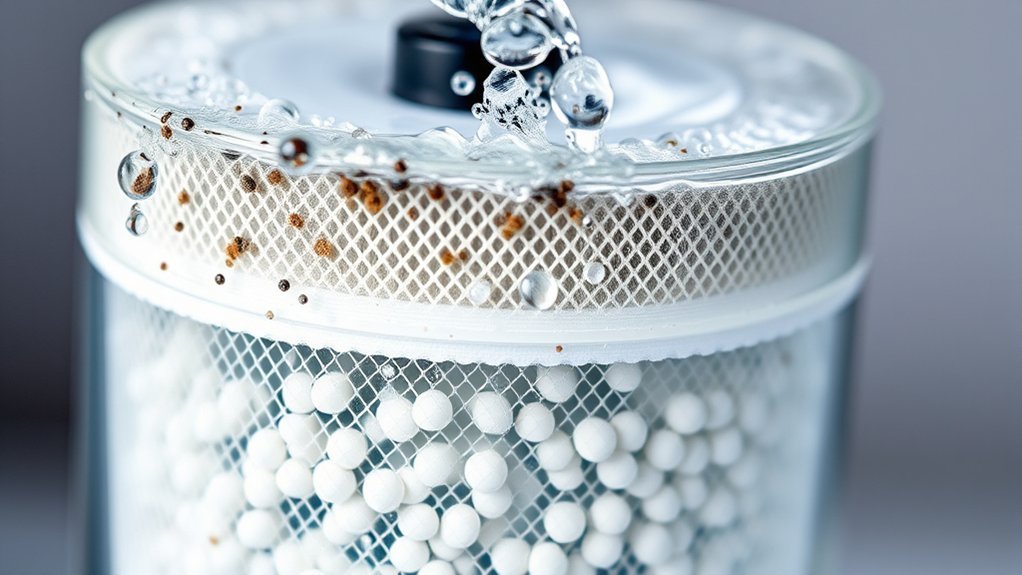
How exactly do water filters remove common contaminants? They operate by employing physical and chemical mechanisms to target impurities. Filtration media trap particulate matter, enabling turbidity reduction by capturing suspended solids that cause cloudiness.
Water filters use physical and chemical methods to trap particles and reduce cloudiness effectively.
Simultaneously, selective permeability ensures essential minerals like calcium and magnesium remain in the water, promoting mineral retention critical for taste and health. Adsorption processes further remove dissolved contaminants such as chlorine and organic compounds by binding them to filter surfaces.
You’ll notice that pore size plays a crucial role; smaller pores block finer particles without stripping beneficial minerals. This balance between contaminant removal and mineral preservation optimizes water quality, ensuring clarity and safety without compromising nutritional value.
In essence, filters use precise mechanical and chemical interactions to refine water efficiently.
Common Water Filter Types
Understanding the mechanisms behind contaminant removal sets the stage for exploring the various filter types designed to implement these processes. You’ll encounter several common water filter types, each utilizing distinct technologies.
Don’t fall for common filter myths that oversimplify or exaggerate capabilities. Proper installation tips are crucial to ensure optimal performance and longevity.
| Filter Type | Key Characteristics |
|---|---|
| Activated Carbon | Adsorbs chlorine, organic compounds |
| Reverse Osmosis | Uses membrane to remove dissolved solids |
| UV Purification | Employs ultraviolet light to neutralize microbes |
Choosing the right filter requires analyzing water quality and usage context. You’ll avoid inefficiencies by understanding each type’s limitations and installation nuances.
How Mechanical Filtration Works

You’ll find mechanical filtration works by physically trapping particles as water passes through specialized filter media. These media vary in composition and pore size, directly influencing the efficiency of particle removal.
Understanding how different materials capture contaminants helps you choose the right filter for your needs.
Particle Removal Process
Why does mechanical filtration play a pivotal role in water purification? It directly targets particle removal by employing surface filtration, which traps contaminants on the filter’s exterior. This process prevents particles from passing through, ensuring cleaner water downstream.
You’ll observe that particle size and filter pore size are critical in determining filtration efficiency. As water flows, particles larger than the pores are captured on the surface, while smaller particles proceed, necessitating further purification stages.
| Parameter | Impact on Filtration |
|---|---|
| Particle Size | Determines capture rate |
| Filter Pore Size | Defines filtration limit |
| Flow Rate | Affects contact time |
Understanding these variables helps you optimize particle removal, enhancing overall water quality through precise surface filtration.
Filter Media Types
How do different filter media types influence mechanical filtration performance? The choice of filter media directly affects particle retention efficiency and flow rate. You must consider media compatibility with the water’s chemical composition and particulate size to optimize filtration.
Common media include sand, activated carbon, and ceramic; each offers distinct pore structures and surface characteristics. Sand filters trap larger particles through depth filtration, while activated carbon adsorbs organic contaminants, enhancing mechanical filtration by reducing clogging.
Ceramic media provide fine porosity for microfiltration but require compatible backwashing protocols to maintain integrity. Ensuring media compatibility with system parameters prevents premature degradation and maintains consistent filtration performance.
Selecting appropriate filter media tailored to your water quality challenges ensures mechanical filtration works efficiently, balancing contaminant removal and hydraulic throughput.
How Activated Carbon Water Filters Improve Taste
Although many water filtration methods focus on removing contaminants, activated carbon filters specifically target compounds that affect taste and odor. Through activated carbon chemistry, these filters adsorb organic molecules and chlorine, which are primary contributors to unpleasant taste.
The porous structure of activated carbon creates a large surface area, enabling efficient removal of taste-impacting substances without altering essential minerals in the water.
You’ll notice the taste improvement because activated carbon filters:
- Adsorb chlorinated compounds that cause bitterness
- Remove volatile organic compounds (VOCs) responsible for odors
- Trap pesticides and herbicides affecting flavor
- Reduce sulfur compounds that create a rotten egg smell
- Maintain mineral balance for natural taste enhancement
This targeted adsorption explains why activated carbon filters are essential for improving water palatability.
How Reverse Osmosis Water Filters Work
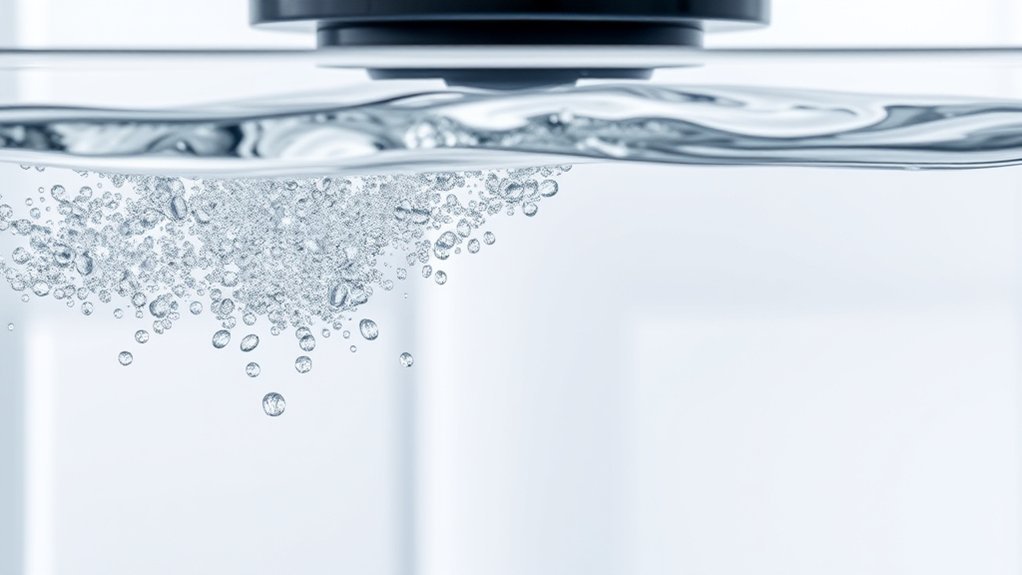
You’ll rely on reverse osmosis to push water through a semi-permeable membrane that blocks contaminants at a molecular level. This filtration process efficiently removes dissolved solids, heavy metals, and other impurities.
Understanding how this membrane works is key to appreciating the system’s contaminant removal capabilities.
Reverse Osmosis Process
Why does reverse osmosis stand out among water filtration methods? It uses pressure to force water through a semipermeable membrane, separating contaminants from clean water. Unlike an irrelevant topic or unsuited concept, this process directly targets dissolved solids, ions, and molecules too small for conventional filters.
When you apply pressure exceeding osmotic pressure, water molecules pass through the membrane while impurities are retained and flushed away. This precise mechanism ensures high purity output.
Key aspects include:
- Application of hydraulic pressure to overcome natural osmotic pressure
- Selective removal of dissolved salts and organic compounds
- Continuous flushing of rejected contaminants
- Dependence on membrane integrity and pore size
- Efficiency influenced by feed water quality and pressure
Understanding this process clarifies why reverse osmosis is a superior filtration method.
Membrane Filtration Role
How exactly does the membrane filtration step function within reverse osmosis systems? Membrane filtration relies on a semi-permeable barrier that selectively allows water molecules to pass while blocking dissolved solutes. You apply pressure to overcome natural diffusion limitations, forcing water through the membrane pores.
This process effectively separates contaminants based on size and chemical properties. The membrane’s structure is critical; it balances permeability and selectivity to optimize filtration without excessive energy use.
Diffusion limitations arise from concentration polarization near the membrane surface, which can reduce flux and efficiency. To counteract this, system designs often include flow dynamics that minimize boundary layer buildup.
Contaminant Removal Efficiency
What determines the effectiveness of a reverse osmosis system in removing contaminants? You need to consider factors influencing contaminant kinetics and filtration reliability. The system’s ability to efficiently separate impurities depends on membrane pore size, pressure applied, and water composition.
Understanding these variables helps optimize contaminant removal.
Key factors affecting contaminant removal efficiency include:
- Membrane permeability and selectivity controlling solute passage
- Operating pressure influencing contaminant kinetics through the membrane
- Feedwater quality impacting membrane fouling and system reliability
- Temperature affecting diffusion rates and filtration performance
- Maintenance frequency ensuring consistent filtration reliability
How UV Water Filters Purify Water
When you expose water to ultraviolet (UV) light, you disrupt the DNA and RNA of microorganisms, rendering them incapable of reproduction and infection. UV disinfection operates by emitting UV-C light at a germicidal wavelength, typically around 254 nanometers.
This energy penetrates microbial cells, causing molecular damage that inhibits their metabolic functions. Unlike chemical treatments, UV disinfection does not introduce any substances into the water, preserving its chemical composition and enhancing water purity.
For effective purification, the water must have low turbidity to allow UV light penetration and sufficient exposure time to ensure microbial inactivation. UV water filters require regular maintenance to clean quartz sleeves and monitor lamp intensity, as diminished output reduces disinfection efficacy.
Choosing the Right Water Filter for Your Needs
UV water filters provide a chemical-free method to eliminate microorganisms, but selecting the appropriate water filter depends on various factors including water quality, contaminants present, and your specific needs. When evaluating options, consider prospective pros and user concerns carefully to ensure optimal performance and safety.
To choose the right water filter, analyze these critical aspects:
- Contaminant profile: Identify pollutants like chlorine, lead, or sediments.
- Filter type: Match technologies (carbon, reverse osmosis, UV) to contaminants.
- Flow rate and capacity: Ensure it meets your household water demand.
- Certification standards: Verify compliance with NSF/ANSI protocols.
- Maintenance requirements: Assess filter lifespan and replacement ease.
Addressing these analytic criteria helps you select a solution that aligns precisely with your water purification goals and user priorities.
Frequently Asked Questions
How Often Should I Replace My Water Filter?
You should follow the replace frequency outlined in your maintenance schedule, typically every 3-6 months. Consider filtering stages’ lifespan and use installation tips to ensure timely replacement.
This helps maintain optimal performance and water quality consistently.
Can Water Filters Remove Viruses?
Water filters generally can’t guarantee virus removal due to virus removal limitations tied to filtration media types.
Only specialized filters, like ultrafiltration or those with added antiviral treatments, effectively reduce viral contaminants in water.
Are Water Filters Safe for Well Water?
You can safely use water filters for well water if they meet strict filtration standards. Regularly test well water safety, and choose filters certified to remove specific contaminants common in groundwater for reliable purification results.
Do Water Filters Affect Water Pressure?
Yes, water filters can affect water pressure due to flow restrictions caused by filter media.
You’ll notice water pressure impact increases as filter lifespan limitations cause clogging, requiring timely replacements to maintain optimal flow and filtration efficiency.
How Do I Maintain and Clean My Water Filter?
You should establish regular cleaning routines by flushing the filter and replacing cartridges as specified. Perform filter calibration periodically to ensure optimal performance.
Document maintenance schedules to prevent clogging and maintain consistent water flow and quality.
Conclusion
Now that you understand how different water filters trap particles, adsorb contaminants, and neutralize microbes, which system fits your water quality needs best?
Mechanical filters excel at removing solids, activated carbon improves taste by adsorbing chemicals, reverse osmosis reduces dissolved solids, and UV ensures microbial safety without altering chemistry.
Choosing the right filter means analyzing your water’s specific issues and selecting technology that targets those contaminants efficiently and reliably. Ultimately, understanding how a water filter works will help you make the best choice for clean and safe water.